
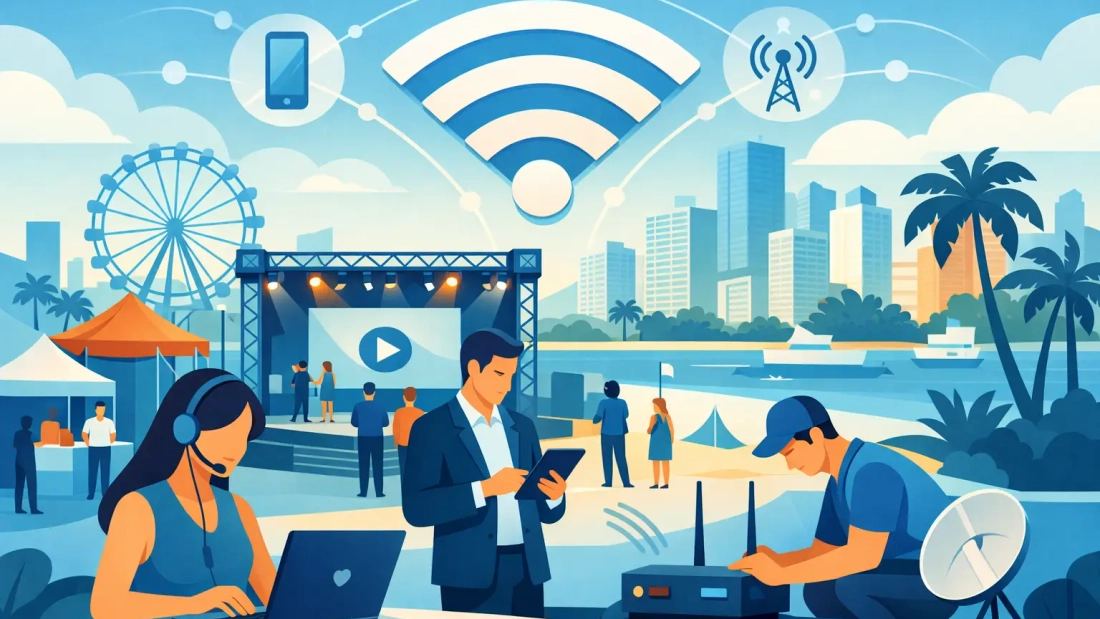
A keynote is about to start, badge printers are backed up, exhibitors are testing payment terminals, and the livestream team is asking for a dedicated line. That is the moment when event internet service Miami planners chose weeks earlier either proves itself or becomes the problem everyone is talking about.
For business events in Miami, internet is not a convenience. It is part of the event operation. Registration, POS systems, presentation uploads, video production, guest Wi-Fi, exhibitor demos, hybrid sessions, and staff communication all depend on stable connectivity. If the network drops, the event does not just slow down. Revenue, attendee experience, and brand credibility take a hit.
Why event internet service in Miami needs a business-first plan
Miami is a high-demand event market. Convention spaces, hotels, waterfront venues, pop-up sites, and outdoor activations all create very different network conditions. A ballroom hosting a leadership summit has one set of demands. A trade show floor with hundreds of devices and sponsor booths has another. An outdoor branded event near the beach introduces a completely different level of planning.
That is why event internet service in Miami should not be approached like standard office Wi-Fi or a consumer hotspot setup. Event traffic is concentrated, time-sensitive, and often public-facing. A small failure at the network level can turn into visible delays at check-in, poor video quality during presentations, or outages at vendor stations.
The right setup starts by asking operational questions, not just speed questions. How many people will be connected at once? Are exhibitors running cloud-based demos? Will the AV team need a separate circuit? Are credit card transactions part of the event flow? Is there a livestream with upload-heavy traffic? Those details shape the service design.
What businesses actually need from event internet service Miami providers
Reliability is the first priority, but reliability means more than having a signal. It means enough capacity for peak use, proper network design, and support that responds quickly if conditions change during the event.
For most business events, symmetrical bandwidth matters more than many planners expect. Download speed gets attention because people associate it with general internet performance. But events increasingly rely on strong upload performance for video calls, streaming, cloud backups, content posting, production feeds, and real-time collaboration. A connection that downloads well but struggles on uploads can become a bottleneck fast.
Dedicated capacity can also matter. Shared connections may be acceptable for light guest browsing, but they are often a bad fit for mission-critical event functions. If registration, production, and transactions all share the same pool of bandwidth as attendee devices, performance can become unpredictable when the room fills up.
Support matters just as much as the circuit itself. Events run on timelines that leave no room for long troubleshooting chains. You want a provider that understands the business impact of downtime and can coordinate with venue teams, AV vendors, exhibitors, and operations staff without turning every issue into a back-and-forth.
Venue internet vs. dedicated event service
Many venues advertise internet access, and sometimes that is enough. For a small internal meeting with limited device counts, light web usage, and no production needs, the venue’s existing service may work fine. The problem is assuming that advertised availability equals event readiness.
Venue internet is often shared across the property. That can create performance swings based on what else is happening onsite. A connection that looked acceptable during a site visit may behave very differently when multiple groups are active or when guest demand rises.
Dedicated event internet is usually the better choice when the connection supports registration systems, exhibitor operations, payment processing, livestreaming, press activity, or executive presentations. It gives the event team more control over bandwidth allocation, network segmentation, and performance expectations. It also reduces the chance that unrelated traffic elsewhere in the building affects core event functions.
There is a trade-off, of course. Dedicated service may cost more than relying on house internet. But for most revenue-generating or brand-sensitive events, that extra investment is minor compared with the cost of operational failure.
Planning bandwidth for real event usage
One of the biggest mistakes in event planning is estimating internet needs by attendee count alone. Two events with the same headcount can have completely different network requirements.
A 200-person meeting where attendees occasionally check email is not the same as a 200-person product launch with media uploads, social posting, digital signage, demo stations, and a high-definition livestream. The applications running on the network matter more than raw headcount.
Registration and ticketing need consistency more than extreme speed. If badge printing stations lag, lines build quickly. Payment systems require stable, secure connectivity. Exhibitors often need isolated access for demos, lead capture, or transactions. Production teams may need dedicated bandwidth for streaming and presenter support. Staff also need their own dependable access for communication, logistics, and issue tracking.
Guest Wi-Fi adds another layer. If you offer attendee access, it should be planned separately from operational traffic. Combining everything into one flat network may be simpler on paper, but it creates avoidable risk. Segmentation helps preserve performance for critical functions, even if guest usage spikes.
Indoor, outdoor, and temporary site challenges
Miami events do not all happen in controlled conference environments. Many are held in outdoor venues, temporary structures, branded installations, or nontraditional spaces. That changes the technical approach.
Outdoor events may require temporary deployment methods, longer cable runs, wireless point-to-point links, weather-aware equipment placement, and stronger contingency planning. Heat, humidity, crowd movement, and layout changes can all affect performance. A network that works in a hotel meeting room is not automatically suitable for a waterfront activation or festival-style footprint.
Temporary sites also tend to involve more coordination. Power availability, physical access, setup windows, and security all influence how event internet should be delivered. This is where local experience matters. A provider familiar with South Florida venues and logistics can spot issues earlier and recommend practical solutions before install day.
Security is part of the event experience
For business events, internet service is not just about speed. It is also about protecting business activity. Guest networks, payment traffic, internal operations, and exhibitor systems should not all live on the same access path.
A properly designed event network can separate different user groups and reduce exposure. That is especially important when sensitive business information, transactions, or internal communications are involved. Not every event needs the same level of security design, but every business event should think beyond simple connectivity.
This is another area where the cheapest option can create expensive problems. If the network is easy to join but hard to manage, your event team may end up dealing with access issues, unauthorized use, or degraded performance at the worst possible time.
What to ask before choosing an event internet provider
The best buying questions are practical. Ask whether the provider has handled similar event sizes and formats. Ask how bandwidth is allocated between public and operational uses. Ask what support is available during setup and live event hours. Ask whether redundancy is available if the event cannot tolerate downtime.
You should also ask how the provider works with venues and third-party vendors. Event internet is rarely a standalone deliverable. It touches AV, registration, exhibitor services, and often venue operations. Coordination is part of the service.
A strong provider will not give the same answer to every event. They will ask about attendance, applications, floor plan, production needs, and timing because the right solution depends on how the event functions in real life.
Why local support makes a difference in Miami
When an event has a connectivity issue, no one wants to hear that support is remote, delayed, or unfamiliar with the venue environment. Miami events move fast, and so do expectations from attendees, sponsors, and executives.
Local business providers have an advantage here. They understand the region, the venue mix, and the urgency of on-site troubleshooting. They are also better positioned to recommend the right service level based on actual commercial needs instead of generic package tiers. That is especially valuable for companies running recurring events across South Florida or managing high-visibility launches where internet performance is part of the brand experience.
AWBC approaches event connectivity the same way it approaches business internet more broadly: as an operational requirement, not a commodity purchase. That mindset tends to lead to better planning and fewer surprises on event day.
The right event internet service should feel invisible once the doors open. Registration should move, presentations should load, transactions should process, and your team should stay focused on the event itself instead of the network behind it. If your event depends on connected systems, that level of preparation is not extra. It is part of running the event well.