
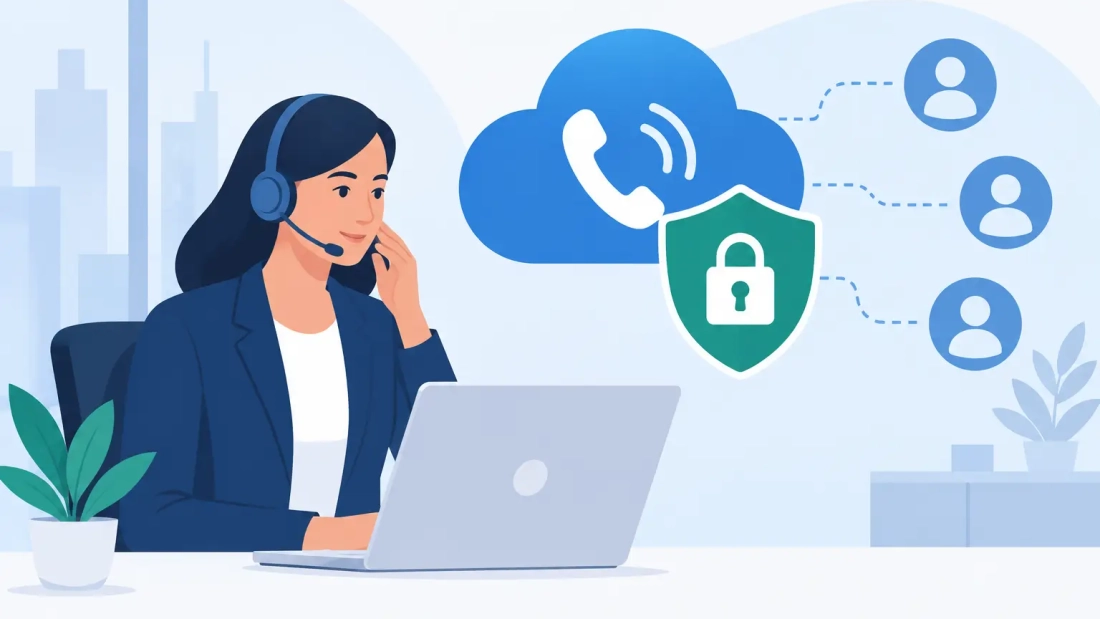
A fraudulent international call burst can create thousands of dollars in charges before a business opens for the day. A compromised voicemail account can expose customer details. And when voice service fails during a busy period, employees may have no reliable way to reach customers, vendors, or each other. VoIP security is therefore not just an IT concern. It is part of protecting revenue, customer trust, and day-to-day operations.
For South Florida businesses using cloud phone systems, the goal is practical: keep authorized calls flowing while making it much harder for criminals, compromised devices, and network failures to interrupt service. That requires more than choosing a phone provider. It requires sensible account controls, a dependable business network, and a clear plan for what happens when something looks wrong.
What VoIP Security Protects
Voice over Internet Protocol moves calls over an IP network rather than traditional phone lines. That flexibility lets teams make and receive calls from desk phones, mobile apps, laptops, and multiple offices. It also means a phone system has some of the same security considerations as other cloud-based business applications.
The most obvious concern is call privacy. Businesses may discuss payment details, employee information, contracts, health information, or operational plans over the phone. Encryption can help protect call signaling and audio from interception, but it must be configured correctly across the provider, devices, and network.
Security also protects access. If an unauthorized user gains administrative credentials, they may change call routing, create extensions, access voicemail, or place expensive calls. In some cases, attackers use compromised accounts for toll fraud, routing high volumes of international or premium-rate calls through a business phone system.
Availability matters just as much. A phone system can be secure against unauthorized access and still be unavailable because of an internet outage, power loss, misconfigured firewall, or denial-of-service attack. For a business that relies on incoming calls for appointments, sales, dispatch, or customer support, availability is a security outcome.
The VoIP Security Risks Businesses See Most Often
Most incidents do not begin with a highly sophisticated attack. They start with a reused password, an employee who approves a fake login page, a phone left on an open guest network, or a system setting that was never reviewed after installation.
Credential theft is one of the most common paths. A criminal may obtain a user or administrator password through phishing, password reuse from another breached service, or weak account recovery practices. Once inside, they can look for high-value settings such as call forwarding rules, voicemail access, user permissions, and international dialing.
Toll fraud deserves particular attention because its financial impact can be immediate. Attackers may take control of an extension or PBX administration portal, then generate large call volumes outside normal business hours. International calling restrictions, spending thresholds, and alerting rules can substantially limit exposure.
Eavesdropping is another concern, especially when calls travel over unsecured Wi-Fi or poorly segmented networks. Encryption reduces the risk, but it does not compensate for weak user access controls or unmanaged devices. A business should treat softphone apps and desk phones as endpoints that need appropriate oversight.
Service disruption can come from outside attackers, but it can also be self-inflicted. An overloaded internet connection, poor quality of service settings, aging network hardware, or a single point of failure can cause choppy audio, dropped calls, or complete outages. The cause may not look like a security incident at first, but the operational result is the same: employees cannot communicate reliably.
Build Security Around Identity First
Strong identity controls are the highest-value place to begin. Every person who administers the phone platform should have an individual account. Shared administrator credentials make it difficult to see who changed a setting, and they are hard to secure when employees change roles or leave the company.
Use long, unique passwords and require multi-factor authentication wherever the platform supports it. Multi-factor authentication is especially valuable for system administrators, billing contacts, and users with access to call recordings, voicemail, or reporting data. It adds a second checkpoint when a password has been stolen.
Permissions should match each employee’s job. A receptionist may need to manage call queues and greetings, while a department manager may need reports, and only a limited group should be able to create users, alter routing, or change billing-related settings. This approach reduces the damage that can result from a single compromised account.
Offboarding needs the same attention as onboarding. Disable former employees’ extensions, softphone access, voicemail access, and administrator rights promptly. Review call forwarding rules during this process. A forwarding rule that silently sends calls to a former employee’s personal device can become both a customer service problem and a data exposure issue.
Secure the Network That Carries Your Calls
Call quality and security are closely connected to network design. Business voice traffic should not compete without limits against guest Wi-Fi, large downloads, backups, surveillance cameras, or personal streaming. A properly configured network can prioritize real-time voice traffic so conversations remain clear when the office is busy.
Network segmentation is a practical control. Separating voice devices from guest access and general employee traffic limits how easily a problem on one part of the network can reach another. It also makes troubleshooting more straightforward when call performance changes.
Firewalls should be configured to support the specific voice service in use, not opened broadly as a shortcut. Overly permissive settings can expose devices and management interfaces to unnecessary risk. This is an area where provider and IT coordination matters, because incorrect session handling can affect both call security and call reliability.
A dependable connection is equally important. Businesses with high call volumes, cloud applications, video meetings, and multiple locations benefit from bandwidth that is sized for real demand rather than best-case assumptions. Symmetrical business fiber can be particularly valuable where teams upload large files, run cloud backups, and make concurrent calls. The right capacity will depend on call volume, codec use, other applications, and whether locations share the connection.
Set Guardrails Against Fraud and Misuse
Good VoIP security uses layers. No single setting prevents every incident, but several focused controls can make fraud far less likely and easier to catch quickly.
At a minimum, businesses should establish these safeguards:
- Restrict international, premium-rate, and high-risk destinations unless specific users require them.
- Set calling limits or spending thresholds that match normal business activity.
- Configure alerts for unusual call volume, after-hours activity, repeated failed logins, and major routing changes.
- Review call forwarding, voicemail-to-email, and user permission settings on a scheduled basis.
- Keep desk phone firmware, routers, firewalls, and softphone applications current.
The right restrictions depend on how the organization operates. A logistics company with international vendors may need broader calling permissions than a local professional office. The practical answer is not to block every destination forever. It is to allow necessary activity deliberately, assign it to the appropriate users, and monitor exceptions.
Call recordings and voicemail require special consideration. They can be useful for training, quality assurance, dispute resolution, and compliance, but they may contain sensitive information. Define who can access them, how long they are retained, and whether recordings should be paused during payment collection or other sensitive discussions. Requirements vary by industry and by the states where participants are located, so businesses should align call practices with their legal and compliance guidance.
Plan for Continuity, Not Just Prevention
A secure voice environment assumes that outages and suspicious events can still occur. The question is whether the business can continue serving customers while the issue is addressed.
Document the essential actions in advance: who can contact the voice provider, who can approve emergency call forwarding, which mobile numbers should receive overflow calls, and how employees will communicate if the primary system is unavailable. Test these steps periodically. A continuity plan that has never been tested often fails when time is tight.
Power planning is part of this conversation. Internet equipment, switches, Wi-Fi access points, and phones may need battery backup to keep service available during short power interruptions. For longer disruptions, businesses may need generator support, cellular failover, alternate locations, or preconfigured remote-work options. The right level of redundancy depends on the cost of missed calls and the length of downtime the organization can reasonably absorb.
For organizations with multiple locations, cloud voice can provide useful flexibility. Calls can be rerouted to another office, a remote team, or designated mobile devices when one site loses connectivity. That flexibility works best when routing rules are documented, authorized staff know how to use them, and each location has reliable underlying connectivity.
Make Security a Managed Operating Practice
VoIP systems are not set-and-forget tools. New employees join, vendors change, offices move, phone apps are added, and calling patterns evolve. A quarterly review is often enough for many smaller organizations, while larger or regulated businesses may need more frequent checks.
Review administrator access, active users, dialing permissions, forwarding rules, firmware status, alert recipients, and recent call activity. Look for changes that no longer match the business. This review can also identify performance issues before they become customer-facing problems, such as increasing packet loss during peak hours or a growing number of calls routed to personal devices.
A provider should be able to explain the security and continuity options in plain business terms, not leave critical decisions buried in a portal. AWBC approaches business voice and connectivity as operational infrastructure: the connection, the phone system, and the support process should work together when your team needs them most.
The most useful next step is simple: review who can control your phone system, what happens to calls during an outage, and how quickly your team would know if calling activity suddenly changed. Those answers reveal where to focus first, before a missed call becomes a larger business problem.