
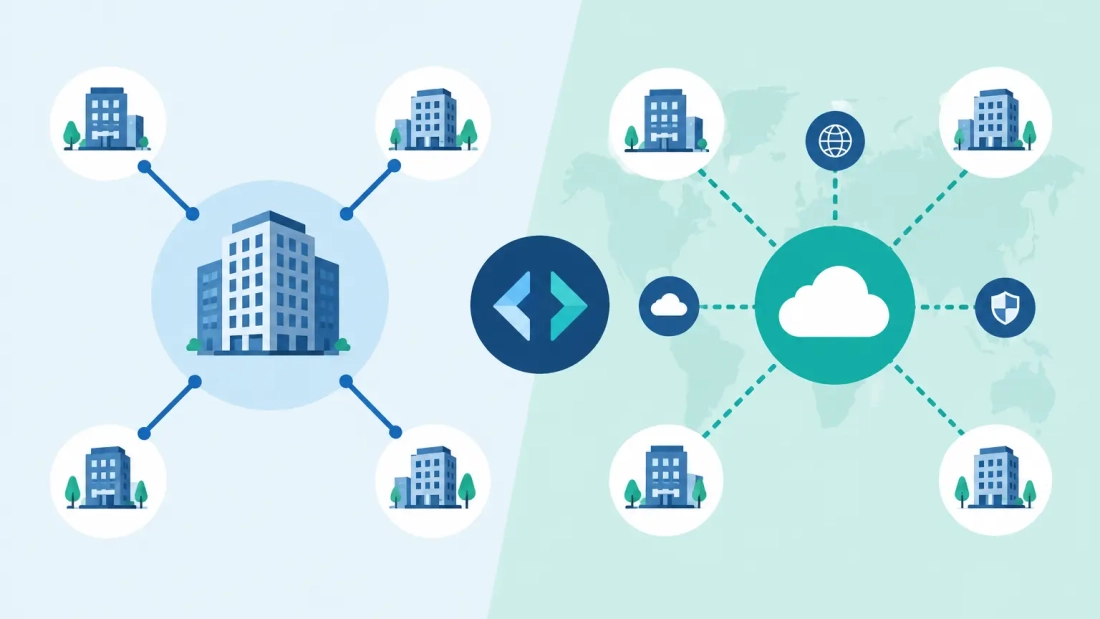
A multi-location business can lose far more than internet access when a network slows down. Cloud applications lag, calls become choppy, point-of-sale systems stall, and employees start working around technology instead of with it. That is why the MPLS versus SDWAN decision deserves more attention than a simple price comparison.
Both technologies connect offices, users, applications, and cloud services. They take different approaches to reliability, traffic control, cost, and flexibility. The better choice depends on how your business operates, what downtime costs, and how much control your team needs over network performance.
MPLS Versus SDWAN: The Core Difference
MPLS, or Multiprotocol Label Switching, is a private wide-area networking service typically delivered through a carrier. Rather than sending traffic across the public internet, MPLS routes it through the provider’s managed network. Businesses have long used it to connect headquarters, branch offices, data centers, and voice systems with predictable performance.
SD-WAN, or software-defined wide area networking, is an overlay that manages traffic across one or more available connections. Those connections can include business fiber, cable broadband, fixed wireless, LTE, 5G, or even MPLS. SD-WAN continuously evaluates link quality and applies rules to send each type of traffic over the best available path.
The practical distinction is straightforward: MPLS is primarily a dedicated network transport service, while SD-WAN is an intelligent traffic-management platform. MPLS can be part of an SD-WAN design, but SD-WAN does not require MPLS to operate.
Why MPLS Still Has a Place
MPLS remains a sensible option for organizations that need highly consistent network behavior between fixed locations. A carrier-managed MPLS circuit generally includes service-level commitments for availability, latency, packet loss, and repair response. For a business with strict application requirements, those commitments can matter.
For example, a company that runs a legacy business application from a central data center may need dependable, low-latency connectivity from every branch. A healthcare organization moving sensitive workloads between facilities may prefer the predictability of a private carrier network. A contact center with a steady, controlled traffic pattern may also benefit from the consistency MPLS provides.
The trade-off is flexibility. MPLS can take longer to install than an internet circuit, especially when a new location requires construction or carrier provisioning. Bandwidth upgrades may also be more expensive than increasing capacity on business fiber internet. As companies shift applications to Microsoft 365, cloud-based CRMs, hosted PBX platforms, and public cloud infrastructure, routing all traffic back through a central MPLS hub can become less efficient.
MPLS is not automatically more secure simply because it is private. It separates traffic from the public internet, which can reduce exposure, but it does not replace firewalls, access controls, endpoint security, or security monitoring. Businesses still need a complete security strategy.
Where SD-WAN Changes the Equation
SD-WAN was built for a business environment where applications, employees, and data are no longer concentrated in one office or data center. It gives IT teams a central way to prioritize traffic and use multiple connections without manually managing every router at every location.
An SD-WAN policy might send voice and video conferencing over the circuit with the lowest latency and jitter, while moving software updates or cloud backups to a secondary connection. If the primary fiber circuit has a disruption, the platform can fail over to another wired connection or cellular backup. This can happen quickly enough to minimize interruption to many business activities.
That path selection is one of SD-WAN’s strongest advantages. Traditional networks often treat every connection as a single route. SD-WAN can assess packet loss, latency, and jitter in real time, then make application-aware decisions. For companies relying on hosted voice, video meetings, cloud file sharing, remote access, and SaaS platforms, that visibility can improve the user experience.
SD-WAN can also make it practical to use high-speed business internet at branch locations instead of relying only on MPLS. In South Florida, where businesses may need continuity planning for weather events, construction damage, or local outages, combining diverse connections can provide meaningful resilience. The key word is diverse. Two circuits that enter the building through the same route or depend on the same local infrastructure may not protect against the same failure.
Cost Is More Than the Monthly Circuit Rate
Businesses often look at MPLS and SD-WAN through the lens of monthly recurring cost. MPLS can carry a higher price per Mbps, particularly at locations that need substantial bandwidth. SD-WAN may lower transport costs by allowing organizations to use business fiber internet and a secondary connection in place of, or alongside, a dedicated MPLS circuit.
But lower circuit cost does not automatically mean lower total cost. SD-WAN requires edge devices or virtual appliances, licensing, deployment, policy design, monitoring, and support. A poorly designed SD-WAN rollout can create confusion rather than improvement, especially if the business has no clear rules for voice, cloud applications, guest Wi-Fi, backups, and critical operational systems.
Likewise, MPLS should not be judged only by its premium. If an application outage stops revenue-producing operations, a predictable carrier service and defined repair commitment may justify the investment. The right comparison accounts for downtime exposure, employee productivity, customer impact, installation requirements, and the internal resources needed to manage the network.
Performance Depends on the Application
Neither MPLS nor SD-WAN is universally faster. MPLS often offers predictable private routing between connected sites. SD-WAN can improve the performance of cloud-based applications by sending traffic directly to the internet rather than backhauling it through a central office.
Consider a law firm with offices in Miami and Fort Lauderdale. If its staff uses cloud document management, Teams calls, hosted VoIP, and online client portals, direct internet access with SD-WAN policies may be a better fit than routing every session through one location. If the same firm also maintains a private application at its main office, it may keep an MPLS path for that workload while using SD-WAN to optimize everything else.
This is why a hybrid approach is common. A business may retain MPLS for highly sensitive or legacy traffic, add dedicated fiber internet for cloud services, and use SD-WAN to decide which path each application should take. The question is not whether one technology has to replace the other. It is whether the network design supports current operations and leaves room for growth.
What to Evaluate Before Choosing
Start with an application inventory. Identify what employees use throughout the day, where those applications are hosted, and what happens when they slow down. Voice, video conferencing, cloud backups, financial systems, customer-facing platforms, and remote desktop sessions have different performance requirements.
Next, review each location. A small office with five users may not need the same architecture as a warehouse, medical office, corporate headquarters, or call center. Check available fiber services, building access, wireless backup options, existing contracts, and the physical diversity of proposed circuits.
Then define the level of accountability you need from providers. Ask about uptime commitments, installation timelines, monitoring, escalation procedures, repair targets, and who supports the network after deployment. A network is only as useful as the response when something goes wrong.
Finally, plan for failure rather than assuming it will never happen. Determine which systems must stay online, how quickly they must recover, and whether cellular backup, secondary internet, or a separate carrier path is needed. Business continuity is not a feature added at the end of a project. It should shape the design from the beginning.
A Practical Decision Framework
MPLS is often a strong fit when your business has fixed sites, centralized applications, strict performance commitments, and a preference for carrier-managed private connectivity. It can be especially valuable where consistency between locations matters more than rapid bandwidth changes.
SD-WAN is often a better fit when cloud applications drive daily work, locations need flexible bandwidth, or the business wants to combine fiber internet with backup connectivity. It gives organizations more control over how traffic moves and can support a more resilient design when paired with properly diverse circuits.
For many companies, the best answer is neither a full MPLS replacement nor an SD-WAN deployment for its own sake. It is a network built around real application needs, reliable local connectivity, and a recovery plan that protects employees and customers when the unexpected happens. Before selecting a platform, map how work actually moves through your business. That conversation usually reveals the network priorities that matter most.