
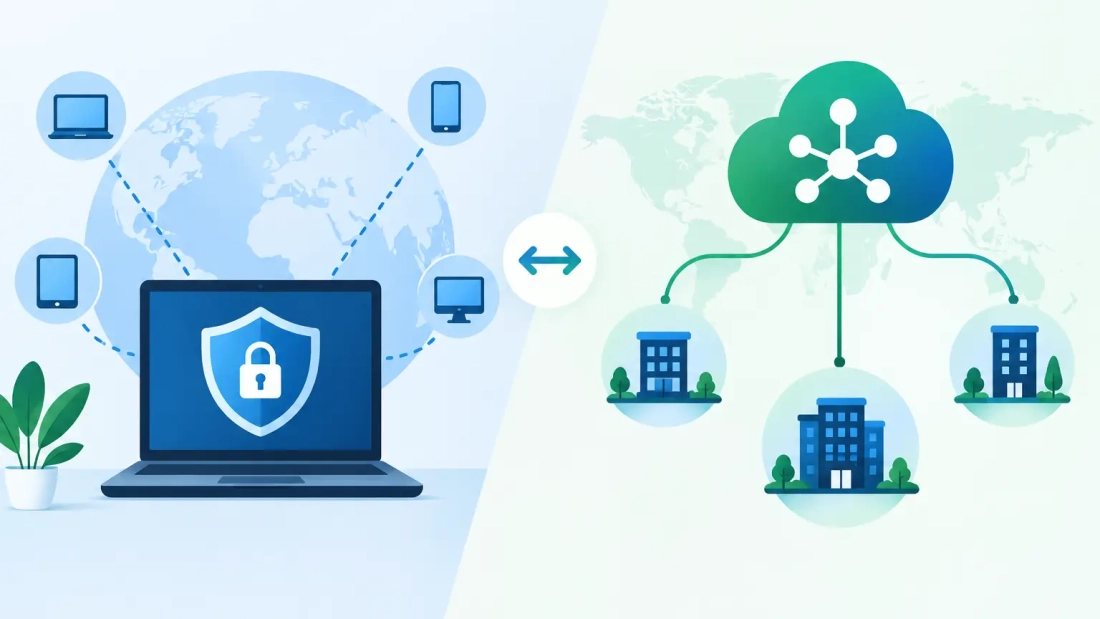
A dropped video call with a key client, a slow cloud backup, or an office that loses access to its phone system can expose a network problem fast. The VPN versus SDWAN decision is not simply about choosing a security tool or a newer networking term. It is about deciding how your locations, remote employees, cloud applications, and internet connections should work together when uptime matters.
For South Florida businesses, the right answer depends on where people work, what applications keep operations moving, and how much disruption the business can tolerate. A VPN may be exactly what a small office needs. An SD-WAN may be the better fit for a multi-location organization that needs consistent application performance and automatic failover.
VPN Versus SDWAN: The Practical Difference
A virtual private network, or VPN, creates an encrypted connection between a user or location and another network. For example, an employee working from home can use a VPN to access files, accounting systems, or internal applications at the office without exposing that traffic to the public internet. A site-to-site VPN can also connect a branch office to headquarters.
A VPN is primarily about private, encrypted access. It is familiar, widely supported, and often cost-effective. For a business with one main office and a limited number of remote staff, it can provide a sensible way to protect access to internal resources.
SD-WAN, short for software-defined wide area networking, takes a broader role. It connects multiple business locations, internet circuits, cloud services, and applications through centralized policies. Rather than treating all traffic the same, SD-WAN can recognize business-critical traffic and steer it over the connection that is performing best.
That distinction matters when a company relies on hosted PBX, VoIP calling, Microsoft 365, cloud-based line-of-business software, video conferencing, and offsite backups. SD-WAN can prioritize voice and video over lower-priority traffic, such as a large software update or a guest Wi-Fi download. It can also switch traffic to a secondary connection when the primary circuit has an outage or severe performance issue.
Where a VPN Is the Right Fit
VPNs remain useful because they solve a specific problem well: secure access. A company with a single office, a stable business fiber connection, and a few remote employees may not need the additional controls of an SD-WAN environment.
A VPN is often a good fit when employees primarily need access to internal files or systems and most work happens from one location. It can also support temporary remote access needs, such as an accountant working from home during month-end close or an IT provider performing approved maintenance.
Cost and simplicity are important advantages. Many business-grade firewalls and routers include VPN capabilities, which can reduce the need for separate hardware or a major network redesign. However, that simplicity can fade as more users, offices, applications, and internet connections are added.
VPN performance also depends heavily on the underlying connection. Encryption adds processing overhead, and traffic may need to travel back through a central office before reaching a cloud application. If a remote employee is trying to join a video meeting while connected through an overloaded office internet circuit, the VPN itself cannot create bandwidth or correct packet loss.
When SD-WAN Earns Its Place
SD-WAN is designed for organizations that need more control across a distributed network. A law firm with offices in Miami and Fort Lauderdale, a healthcare organization with several clinics, or a company with a warehouse, corporate office, and remote sales team may benefit from centrally managed traffic policies and connection redundancy.
The most valuable SD-WAN feature is often intelligent path selection. An SD-WAN device can continuously measure latency, jitter, and packet loss across available connections. If voice traffic begins performing poorly on one circuit, the system can move it to a healthier path based on the rules your business sets.
This is particularly useful for voice services. A phone call does not need massive bandwidth, but it does need stable delivery. High latency, jitter, and packet loss can create choppy audio, delays, and dropped calls. SD-WAN can give hosted PBX and VoIP traffic priority over less time-sensitive internet activity.
SD-WAN can also make practical use of more than one connection. A business might combine dedicated fiber internet with a secondary cable circuit or wireless backup. The goal is not necessarily to use every connection equally. The goal is to keep critical operations available if a provider issue, construction incident, equipment failure, or local disruption affects one path.
For businesses that cannot afford to wait for manual troubleshooting during an outage, this automated failover can be a major operational advantage.
Security Is Not Identical in Both Models
VPNs are known for encryption, but encryption alone is not a complete security strategy. A VPN protects data in transit between approved endpoints. It does not automatically control every application, inspect every threat, enforce employee device standards, or prevent an authorized user from making a mistake.
SD-WAN can include encrypted tunnels between locations, and many platforms integrate with next-generation firewall, secure web gateway, or zero-trust access services. The exact security capabilities vary by provider and configuration. Businesses should ask what is included, where traffic is inspected, how access is authenticated, and who monitors alerts.
Neither solution removes the need for sound operational controls. Multi-factor authentication, endpoint protection, user permissions, firmware updates, network segmentation, and a documented response process still matter. For a smaller organization, a well-configured firewall and VPN may be appropriate. For a larger organization, SD-WAN can provide a more manageable framework for applying consistent policies across sites.
The Internet Connection Still Sets the Foundation
SD-WAN can improve how traffic uses available connections, but it cannot replace a reliable primary circuit. If every application runs over an undersized or unstable internet service, smarter routing has limited room to help.
That is why business fiber is often the starting point. Symmetrical upload and download speeds support cloud backups, large file transfers, video meetings, hosted phone systems, and remote access without forcing one activity to compete unfairly with another. Unlimited data and clear service-level commitments also reduce uncertainty for businesses with sustained daily usage.
A strong design often pairs dependable fiber with a secondary connection for continuity. SD-WAN then provides the intelligence to direct applications across those paths according to business priorities. In a simpler environment, a quality fiber connection plus a properly configured VPN may be all that is necessary.
Questions That Clarify the Decision
Before choosing between a VPN and SD-WAN, look at the workflow rather than the acronym. How many locations need to share applications and data? How many employees work remotely? Are cloud platforms central to daily operations? What happens to revenue, customer service, or production if the primary internet connection fails for an hour?
Also consider which traffic is most sensitive to disruption. If your business depends on hosted voice, video conferencing, point-of-sale systems, real-time inventory, or cloud desktops, consistent performance matters more than basic connectivity. If a secondary circuit exists, determine whether failover is manual or automatic and whether critical applications receive priority during a disruption.
Management requirements deserve equal attention. A VPN may be straightforward for a small team, but adding users, offices, and exceptions can become difficult to track. SD-WAN can centralize policies and visibility, but it requires careful planning, proper configuration, and a provider that can support the design after installation.
Choose for the Business You Operate, Not the Label
A VPN is not outdated, and SD-WAN is not automatically necessary. VPNs remain effective for secure remote access and straightforward site connections. SD-WAN becomes valuable when a business needs application-aware performance, multiple connection paths, centralized management, and stronger continuity across locations.
The best approach begins with an assessment of your internet service, voice requirements, cloud usage, office locations, and tolerance for downtime. AWBC helps South Florida businesses evaluate those operational needs before recommending connectivity built around them. A clear network plan should make the next outage less disruptive, the next video call more reliable, and the next stage of growth easier to support.