
A phone system decision becomes urgent when calls start dropping, employees need to work from another location, or an office move exposes how much aging equipment is holding the business back. For South Florida organizations, the hosted PBX vs onsite PBX conversation is not just about phone features. It is about keeping customer calls answered, teams productive, and operations running when conditions change.
Both options can support professional business communications. The better fit depends on how your company operates, how much internal IT capacity you have, and how much flexibility you need over the next several years.
Hosted PBX vs Onsite PBX: The Operational Difference
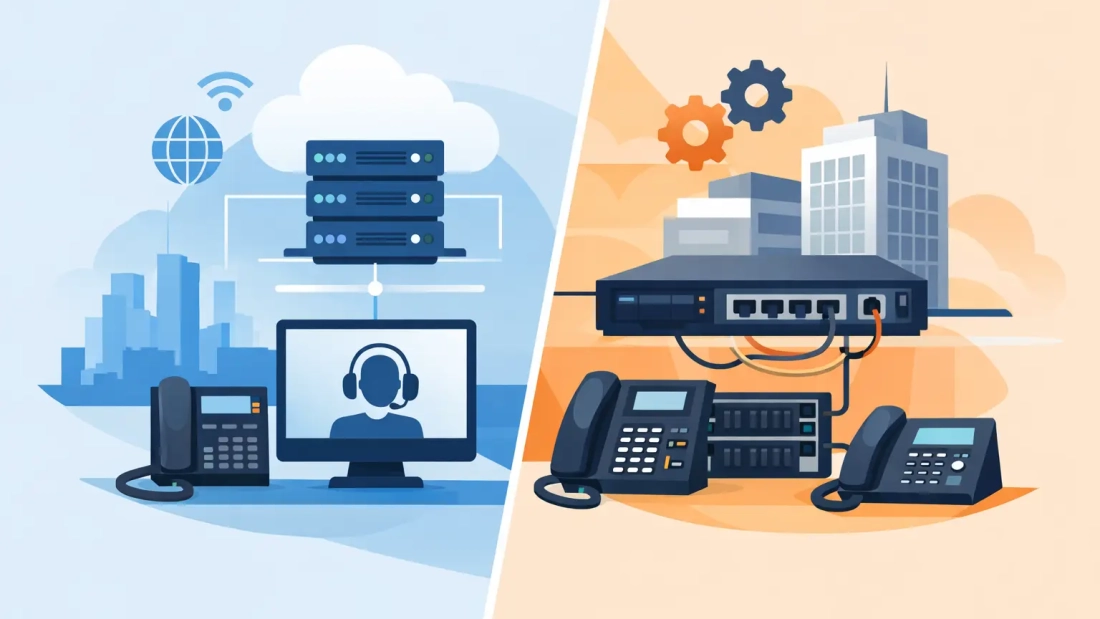
An onsite PBX is a private branch exchange system installed at your physical office or facility. Your business owns or leases the phone server, related hardware, and often the responsibility for maintaining it. Desk phones, wiring, software licensing, trunks, and system updates are typically tied to equipment on premises.
A hosted PBX moves the central phone system into a provider-managed cloud platform. Users still have desk phones if they want them, but they can also make and receive calls through desktop applications and mobile devices. The phone system works over a business-grade internet connection rather than relying on a PBX server in a communications closet.
That distinction affects everything from upfront cost to disaster recovery. With an onsite system, the business has direct control over its equipment. With a hosted system, the provider handles the platform infrastructure while the business manages users, call settings, and permissions through an administrative portal.
Cost: Capital Expense vs Predictable Monthly Service
Onsite PBX systems usually require a larger initial investment. Hardware, installation, configuration, handsets, licenses, and potentially new cabling can create meaningful upfront costs. For an established company with a long-term facility and a specialized phone environment, that investment can be reasonable.
The ongoing expense matters as much as the purchase price. Onsite equipment eventually needs software updates, replacement components, maintenance contracts, and qualified support when a problem occurs. A system that appears less expensive after installation can become costly if it requires frequent service or is difficult to expand.
Hosted PBX generally shifts the model to a monthly per-user or per-seat expense. This can make budgeting easier for businesses that prefer to preserve capital for inventory, staffing, expansion, or other operating priorities. Installation and handset costs may still apply, but the financial barrier is typically lower than deploying an equivalent onsite system.
Hosted service is not automatically the lowest-cost option in every scenario. A very large organization with stable staffing, existing telecom expertise, and highly customized requirements may find that owning equipment makes financial sense over a long period. Most small and midsize businesses, however, benefit from avoiding a major technology purchase that begins depreciating on day one.
Reliability Depends on More Than the PBX
An onsite PBX can continue routing internal extension-to-extension calls during an internet outage, depending on the system design. But external calling often still depends on local carrier circuits, power, and the condition of the equipment in the building. If the office loses power or becomes inaccessible, the PBX may be unavailable along with it.
Hosted PBX places the core system in geographically managed data centers rather than at one office. If employees can access a stable internet connection somewhere else, they can often continue taking business calls from another location or a mobile device. Incoming calls can be redirected quickly to alternate users, departments, or locations.
That advantage depends on the network. Voice traffic needs sufficient bandwidth, low latency, proper network configuration, and dependable uptime. A consumer-grade connection may be adequate for a handful of occasional calls, but it can create call-quality issues when the office is also running video meetings, cloud backups, large file transfers, and guest Wi-Fi.
For businesses that rely heavily on hosted voice, a business fiber connection with symmetrical speeds, service-level support, and appropriate network design is part of the phone system decision. The PBX and internet connection should be evaluated together, not as separate purchases.
Flexibility for Growing and Distributed Teams
Onsite PBX works best when employees, workstations, and calling patterns remain largely fixed. Adding users may require new licenses, extension cards, handsets, and onsite configuration. Moving an employee or opening a new office can involve a technician visit and more hardware planning.
Hosted PBX is built for change. A new employee can receive an extension, voicemail, calling permissions, and an app-based softphone without waiting for a new PBX module to arrive. Seasonal staff, remote employees, satellite offices, and traveling sales teams can use the same business number and calling rules from approved devices.
This is especially useful for companies with offices across Miami-Dade, Broward, and Palm Beach counties. A customer should not need to know whether the person answering is in the main office, at a branch location, or working remotely. Hosted calling keeps the customer-facing experience consistent while giving the business more options behind the scenes.
Control and Customization: Where Onsite PBX Can Win
An onsite system offers deep control for organizations that need it. Businesses with complex call flows, legacy equipment, specialized integrations, or strict internal policies may prefer direct ownership of their phone environment. They can select the hardware, configure it to their specifications, and manage changes internally.
The trade-off is responsibility. Greater control means greater accountability for patches, security, backups, replacement parts, and after-hours troubleshooting. If the person who understands the system leaves the company, the phone environment can become difficult and expensive to support.
Hosted PBX offers a different kind of control. Administrators can usually manage extensions, call forwarding, auto attendants, ring groups, voicemail settings, business hours, and user access without touching physical server equipment. The available customization is designed around common business needs rather than every possible technical scenario.
For most offices, that is a benefit rather than a limitation. The goal is not to own a complex phone server. It is to route calls correctly, provide a professional caller experience, and give employees tools that work wherever business happens.
Security, Maintenance, and Support
Every phone system needs attention. Onsite PBX puts much of that work on the organization or its IT partner. That includes monitoring equipment health, applying updates, securing administrative access, maintaining backups, and diagnosing hardware failures.
With hosted PBX, the provider is responsible for maintaining the central calling platform. Your internal team still needs to manage user access, passwords, device policies, and network security, but it does not need to maintain a PBX server. This can reduce the burden on small IT teams and office managers who already handle a broad range of responsibilities.
Support quality should be a major consideration in either model. Ask who responds when calls cannot be completed, whether support understands your network and voice configuration, and how quickly changes can be made during an operational issue. A phone system is a customer service tool, so delays in support can quickly become revenue and reputation problems.
Which System Fits Your Business?
Hosted PBX is often the stronger choice for companies that want predictable costs, remote-work capability, easier scaling, and less hardware to manage. It is a practical fit for professional offices, retailers, service businesses, multi-location organizations, and growing teams that need to adapt without rebuilding their phone system.
Onsite PBX may be appropriate when a business has a specialized environment, substantial internal telecom expertise, a fixed long-term location, and a clear reason to control its own hardware. It can also make sense where local calling must continue under certain network conditions, provided the system has the right power and carrier redundancy.
Before deciding, map how calls move through your business during a normal day and during a disruption. Consider what happens if the office loses power, an employee works from home, a department grows by ten people, or a customer needs immediate assistance after hours. Those scenarios reveal more than a feature checklist ever will.
A well-planned hosted voice solution, supported by dependable business connectivity, gives many South Florida businesses room to grow without making communications another point of failure. AWBC can help assess the calling and network requirements behind that decision, so the system supports the way your team actually works.