
When a phone contract is up for renewal or an aging PBX starts creating support tickets, hosted voice versus SIP trunking becomes a practical business decision. Both can deliver modern calling features and reduce dependence on legacy phone lines. The right choice depends on what your business already owns, who manages your technology, and how much responsibility you want to keep in-house.
For many South Florida businesses, the larger question is not simply how calls connect. It is whether employees can answer customers from the office, home, or a mobile device when operations change quickly. That is where the differences between hosted voice and SIP trunking matter.
Hosted Voice Versus SIP Trunking Explained
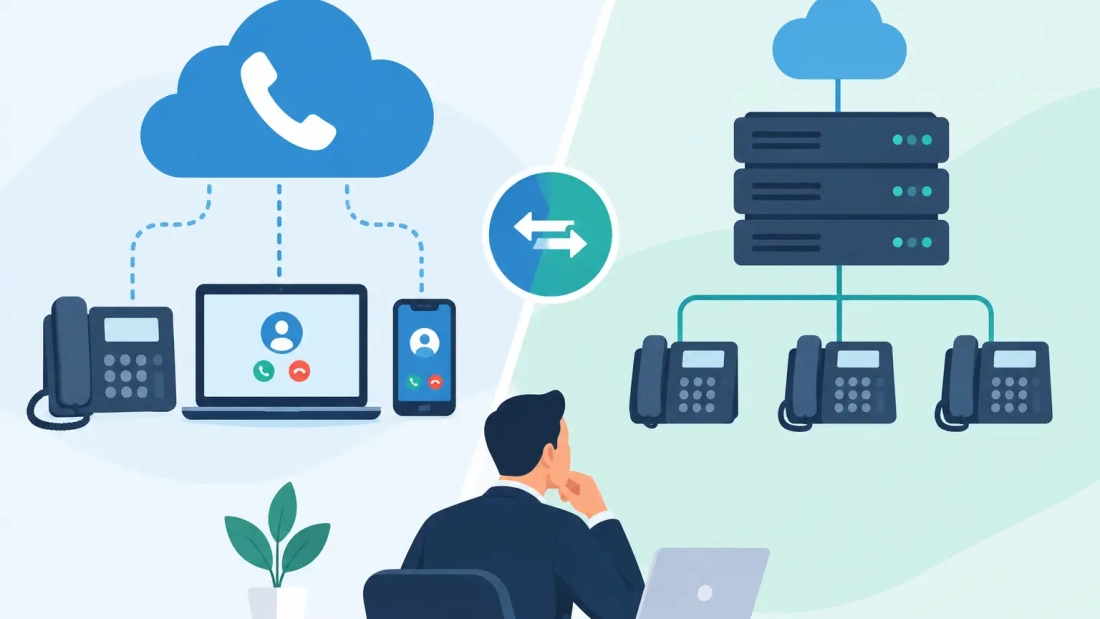
Hosted voice is a cloud-based phone service. The phone system itself runs in the provider’s data center rather than on a PBX server at your office. Users access it through desk phones, desktop applications, and mobile apps, while administrators manage common settings through an online portal.
SIP trunking is a way to connect an existing phone system to the public telephone network using an internet connection. Instead of traditional PRI circuits or analog lines, SIP trunks carry voice calls over IP. Your company typically retains its on-premises PBX or IP-PBX, along with much of the responsibility for its configuration, maintenance, and lifecycle.
Both services rely on reliable business internet. They are not interchangeable, however. Hosted voice replaces much of the on-site phone infrastructure. SIP trunking extends the useful life of infrastructure you already have.
Hosted Voice Fits Businesses That Want Less Phone System Overhead
With hosted voice, the provider maintains the core calling platform. Your business does not need to purchase, house, patch, or replace a PBX server just to run its phones. That can be a significant advantage for a growing office without a dedicated telecom administrator.
Day-to-day management is generally straightforward. An office manager or IT lead can add a user, update a call queue, change office hours, or route calls to another location without scheduling a technician to reprogram a physical phone system. Features such as auto attendants, voicemail-to-email, call forwarding, conferencing, and business texting may also be available in one platform.
This model works especially well for companies with hybrid employees, multiple offices, field personnel, or frequent staffing changes. A new employee can often receive an extension and begin taking calls on a laptop or mobile app before a desk phone arrives. If a Miami headquarters needs calls covered by a Broward or Palm Beach County team, routing can be adjusted without moving lines between sites.
The trade-off is control. Hosted voice platforms are designed around standardized features and supported configurations. That is usually a positive for organizations that want predictable administration, but it can be limiting for businesses with highly customized call flows or specialized integrations. Ask early whether the platform supports your CRM, contact center tools, paging equipment, door entry system, or analog devices.
SIP Trunking Makes Sense When Your PBX Still Adds Value
SIP trunking is often the stronger choice when an organization already owns a capable, well-supported PBX and has internal expertise to manage it. A larger company may have invested heavily in custom routing, integrations, handsets, call recording, or contact center workflows that it does not want to replace immediately.
In that case, SIP trunks can modernize connectivity while preserving the system employees already use. They can also make capacity more flexible than older phone circuits. Instead of ordering a fixed block of traditional channels, businesses can size calling capacity around expected concurrent calls and adjust as demand changes.
The financial picture requires more than a monthly service comparison. SIP trunking can appear economical because the business keeps its existing PBX. But an aging system may bring server replacement costs, software licensing, security patching, consultant fees, and support risk. If the PBX fails, the company is responsible for restoring it.
SIP trunking also requires more planning around network design. Voice traffic must receive priority over less time-sensitive traffic such as large downloads or cloud backups. Firewalls, session border controllers, power protection, and failover routing may all be part of the deployment. Organizations with experienced IT teams can manage these requirements effectively. Companies without that capacity may find the operational burden outweighs the savings.
Reliability Starts With the Connection, Not the Handset
Cloud calling and SIP trunking both depend on internet performance. A fast connection is useful, but voice quality depends on more than headline speed. Packet loss, latency, jitter, congestion, and poorly configured network equipment can lead to clipped audio, delays, or dropped calls.
A business-grade fiber connection with symmetrical speeds gives voice traffic a stronger foundation, particularly when the same office also runs video meetings, cloud applications, file transfers, security systems, and backups. Quality of service settings can prioritize calls during busy periods so a large upload does not disrupt a customer conversation.
Business continuity should be designed before an outage occurs. For hosted voice, administrators can often preconfigure failover rules that send calls to mobile devices, another office, or an answering service if a location loses connectivity. With SIP trunking, continuity may depend on both the carrier’s failover options and the availability of the on-premises PBX. If the PBX has no power or its internet path fails without a backup, call handling can be affected.
South Florida businesses should also consider power events, construction-related fiber damage, and building access issues. A continuity plan may include battery backup for network equipment, a secondary connection, cellular failover, and clearly documented call-routing procedures. The appropriate design depends on the cost of a missed call to your business.
Compare the Full Cost of Ownership
Hosted voice typically uses a predictable per-user monthly model. That structure can simplify budgeting, especially for smaller businesses. It also shifts much of the platform maintenance to the provider, though costs for devices, advanced features, implementation, and specialized integrations should be confirmed upfront.
SIP trunking often combines trunk charges with costs your business already carries or must continue carrying: PBX support, licenses, hardware maintenance, IT labor, security tools, and replacement planning. It can be the more cost-effective model when the PBX is current and supports a large number of users. It can become the more expensive model when the system is near end of life.
Do not compare only the price per user or price per channel. Compare the business outcome. Consider how quickly new users can be added, whether remote staff can work effectively, how calls are handled during an outage, and who resolves problems when a call cannot connect. The answer may favor a different solution for a 15-person professional office than for a 300-seat operation with a dedicated telecom team.
Questions That Clarify the Right Direction
Start with the equipment and expertise you have now. If your PBX is reliable, actively supported, and tightly integrated with core operations, SIP trunking may protect a worthwhile investment. If it is difficult to administer, unsupported, or tied to one location, hosted voice may reduce risk and improve flexibility.
Next, look at workforce patterns. Businesses that need employees to answer the same business number from multiple devices usually benefit from a cloud-first design. Organizations that operate a complex call center, manufacturing facility, hotel, or campus may need a closer review of legacy devices and custom workflows before making a change.
Finally, assess support expectations. A phone system is only useful when someone can answer a customer. Clarify who owns troubleshooting across the internet connection, local network, phones, PBX, and carrier service. A clear support path saves valuable time when an issue affects the entire office.
AWBC helps South Florida businesses evaluate voice service alongside the fiber connectivity and failover planning that keep it dependable. The best phone system is not the one with the longest feature list. It is the one that gives your team a clear, reliable way to serve customers when the office is busy and the stakes are real.