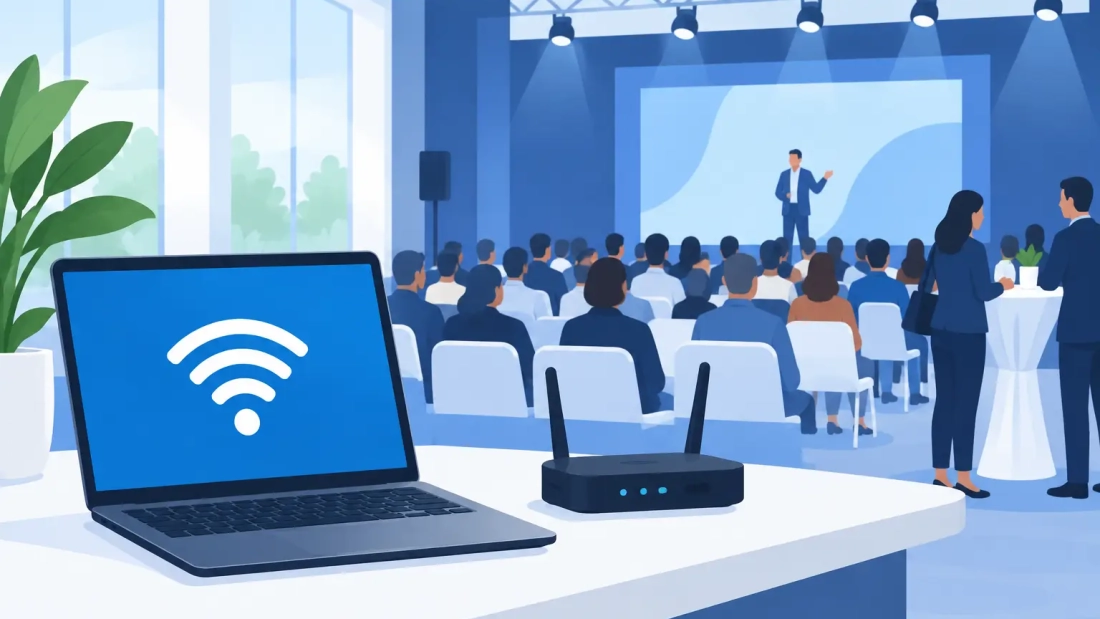
A packed ballroom can expose a weak network faster than almost any other business setting. Attendees join video calls, exhibitors process payments, presenters upload media, and staff coordinate through cloud tools at the same time. The best event internet is not simply the fastest connection available. It is a planned, monitored service designed around what must work when the doors open.
For South Florida businesses planning a conference, trade show, product launch, festival, or temporary activation, internet is now part of the event infrastructure. It affects the guest experience, vendor revenue, event operations, and your brand’s credibility. Choosing the right service starts with understanding demand, venue limitations, and the cost of failure.
Start With What Your Event Needs to Accomplish
An event network should be designed around business activity, not a generic attendee estimate. A 300-person leadership meeting with limited guest access has very different requirements than a 300-person expo where every booth accepts card payments and demonstrates cloud software.
Begin by identifying the activities that cannot stop. These often include point-of-sale terminals, registration systems, production and streaming equipment, event staff communications, exhibitor connections, and guest Wi-Fi. Then separate those critical functions from convenience access, such as general browsing and social media.
That distinction matters because not all traffic should share the same path. If attendees fill the available Wi-Fi capacity with personal devices, a registration desk or payment terminal should not be left competing for bandwidth. A well-designed temporary network uses separate wired or wireless segments to protect essential operations.
It also helps to ask vendors direct questions before the event. How many devices will they connect? Will they upload product videos, run live demonstrations, use cloud applications, or process transactions? A realistic answer is far more useful than a venue’s broad claim that it has Wi-Fi available.
Bandwidth Is Only One Part of the Best Event Internet
Bandwidth gets most of the attention, and it matters. Too little capacity leads to slow uploads, stalled streams, failed transactions, and frustrated guests. But a large bandwidth number does not guarantee a dependable event connection.
The best event internet also considers latency, upload speed, network capacity, coverage, and dedicated support. Latency is the delay between a device request and the network response. Low latency supports clear video calls, responsive cloud applications, and real-time payment processing. Upload capacity matters whenever teams stream presentations, send media files, or share content from the event floor.
For a business event, symmetrical fiber service is often the stronger foundation because upload and download speeds are equally capable. This is especially valuable for hybrid events, live broadcasts, media production, and teams working in cloud-based platforms. In contrast, a connection built primarily for downloads may look fast on paper while struggling during a live upload.
Wi-Fi coverage must be planned separately from the internet circuit. A fast connection entering the venue cannot solve dead zones, overloaded access points, or poor signal placement. Large rooms, concrete walls, exhibit structures, outdoor layouts, and dense crowds all affect wireless performance.
Plan for Device Density, Not Just Attendance
One attendee does not equal one connected device. A guest may carry a phone, laptop, smartwatch, and tablet. Exhibitors may bring multiple terminals, scanners, displays, and employee devices. Production teams often need their own connected equipment as well.
This is why device density is a more useful planning measure than headcount. A 500-person event may place 1,000 or more devices on the network, depending on its format. Even when many devices are idle, they still create management overhead as they connect, disconnect, and look for network access.
A practical network plan also accounts for peak moments. Registration may create a surge early in the day. A keynote can drive simultaneous social posting and streaming. Breaks may cause hundreds of guests to connect at once. The network should be sized for those concentrated periods, not only for average use across the day.
Outdoor events require additional planning. Coverage areas can be broader and less predictable, while weather, power availability, and physical access can affect equipment placement. Temporary connectivity may require a combination of dedicated service, wireless links, and backup options based on the site.
Build Redundancy Around Critical Operations
Every event has a different tolerance for interruption. For a small internal meeting, a short outage may be inconvenient. For a ticketed event, a retail pop-up, or a conference with live streaming, minutes of downtime can create lost sales, delayed entry, and a difficult customer experience.
Redundancy means having a second path available if the primary connection fails. That may include a backup circuit, a secondary wireless connection, or failover equipment that shifts traffic automatically. The right approach depends on the venue, event duration, budget, and importance of the connected services.
Do not treat backup connectivity as an afterthought. If payment processing, registration, or broadcast production depends on the network, test the failover process before guests arrive. A backup that has never been configured or tested is not a business continuity plan.
Power is part of the same conversation. Network equipment, access points, switches, and production systems need dependable power. A continuity plan should identify who is responsible for power access, cable routing, equipment security, and recovery if a circuit or device goes offline.
Choose Support That Matches the Event Schedule
Event internet is a time-sensitive service. A support ticket submitted after a failure is not enough when registration starts in 20 minutes or a speaker is about to go live. Ask who will be available during setup, operating hours, and teardown, and how issues are escalated.
The provider should understand the timeline, venue contacts, technical requirements, and critical applications before installation day. Onsite support may be appropriate for high-profile, complex, or high-density events. For other events, responsive remote monitoring and a clearly defined support process may be sufficient.
The best provider will also coordinate with venue management rather than assuming existing infrastructure can support the plan. Many venues have rules around cable runs, access points, network rooms, installation windows, and approved vendors. Addressing those details early avoids expensive last-minute changes.
Questions to Ask Before You Book Event Internet
Before committing to a service, get clear answers about performance and accountability. Ask whether bandwidth is dedicated or shared, whether upload and download speeds are symmetrical, and whether usage limits apply. Confirm the expected installation timeline and whether the provider has completed a site survey when the event is complex.
You should also ask how guest Wi-Fi is separated from business-critical traffic, what backup options are available, and what support coverage applies during the event. If exhibitors need wired connections or static IP addresses, identify that requirement early. Those needs can affect network design and installation lead time.
Price matters, but the lowest quote can become costly if it excludes equipment, support, setup labor, or the capacity required for peak demand. Compare proposals based on the complete operating requirement, not just the advertised speed.
Make Internet Part of the Event Plan
Internet should be assigned the same planning discipline as power, staging, security, and audiovisual production. Bring the connectivity provider into the process early enough to assess the venue, map coverage, identify critical traffic, and create a workable backup plan.
AWBC helps South Florida organizations approach temporary connectivity as an operational requirement, with business-grade service and practical guidance for the event environment. The goal is not to overspecify the network. It is to provide the capacity, coverage, and support the event actually needs.
When attendees remember the presentation, the product, and the conversations instead of the connection problems, the event network has done its job.