
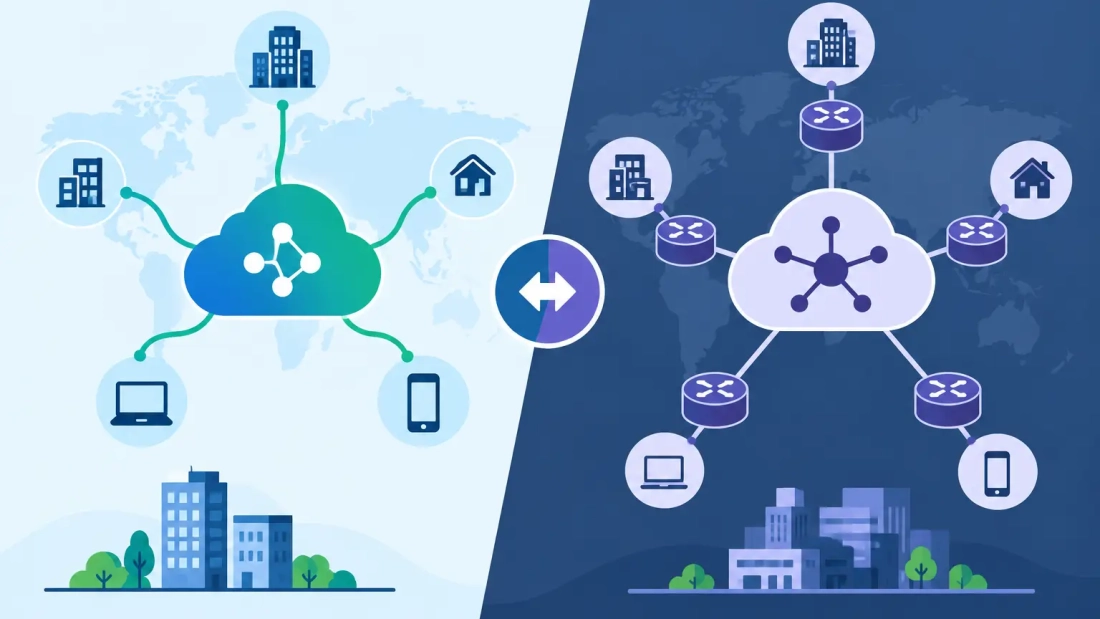
A dropped video call with a key client, a stalled cloud backup, or a POS system that cannot reach the data center is not just an IT inconvenience. It is lost time and, in many cases, lost revenue. The SD WAN versus MPLS decision matters because it determines how reliably your locations, applications, employees, and customers stay connected when business is moving.
For South Florida organizations with multiple offices, remote teams, cloud applications, or critical voice traffic, the right answer is rarely about choosing the newest technology. It is about matching network design to the way your business operates, the cost of downtime, and the performance your teams actually need.
SD WAN versus MPLS: the core difference
MPLS, or Multiprotocol Label Switching, is a private wide-area networking service delivered through a carrier-managed network. Traffic travels on predetermined paths rather than over the public internet. For years, it has been the standard choice for organizations that needed predictable performance between offices and data centers.
SD-WAN, or software-defined wide area networking, uses software to manage and route traffic across one or more connections. Those connections can include business fiber internet, broadband, wireless, and even MPLS. The SD-WAN platform continually evaluates available paths and can direct traffic based on policies such as application type, latency, packet loss, security requirements, and link availability.
The practical distinction is simple: MPLS provides a dedicated, predictable transport service, while SD-WAN provides intelligent control over how traffic uses available transport. SD-WAN is not always a direct replacement for MPLS. In many enterprise deployments, it works alongside MPLS during a transition or supports locations with different connectivity needs.
Why MPLS remains a strong option
MPLS has earned its reputation for a reason. It gives businesses consistent routing and service-level commitments for critical traffic. A company that runs real-time trading systems, centralized call handling, medical applications, or sensitive interoffice workflows may value that predictability more than anything else.
Because MPLS is a private carrier network, it can also simplify quality-of-service planning. Voice, video, and business-critical data can receive defined priority, helping reduce the effects of congestion that may occur on public internet connections. For organizations with legacy applications hosted in a central data center, MPLS can be an effective and stable architecture.
Its limitations are largely operational and financial. MPLS circuits can take longer to provision, especially when a new location needs to be brought online. Bandwidth upgrades may be less flexible than internet-based services, and costs generally rise as locations and capacity increase. MPLS also was designed for a time when most applications lived in a corporate data center. Many businesses now send much more traffic directly to cloud platforms such as Microsoft 365, cloud PBX systems, CRMs, and backup services.
Sending that cloud-bound traffic from a branch office through a central site and back out to the internet can create unnecessary distance and delay. That design is often called backhauling, and it can make a modern cloud application feel slower than it should.
Where SD-WAN changes day-to-day operations
SD-WAN is designed for a more distributed business environment. Rather than treating every application the same, it can recognize traffic and apply rules automatically. A policy might prioritize hosted voice and video conferencing over guest Wi-Fi. It might send cloud backups over a lower-cost secondary circuit while reserving the best path for customer-facing applications.
This is particularly useful when an office depends on multiple connections. A South Florida business might use dedicated fiber as its primary connection and a second internet service or wireless connection as backup. If the primary circuit experiences an outage or performance problem, SD-WAN can move qualifying traffic to the available path with far less manual intervention than a traditional failover setup.
That flexibility can improve business continuity, but it depends on proper design. A failover connection needs enough capacity to support essential operations. If a 500-user office fails over from fiber to a low-bandwidth wireless service, the network may remain technically online while video meetings, cloud software, and voice quality suffer. SD-WAN makes better routing decisions possible. It does not create bandwidth that is not there.
SD-WAN can also reduce the need to route all branch traffic through a central location. Secure local internet breakout lets eligible cloud traffic reach its destination more directly. The result can be better application response times and a more efficient use of bandwidth, especially for teams working in Microsoft 365, cloud storage, SaaS platforms, and hosted communications.
Cost is more than the monthly circuit price
A lower-cost internet connection can make SD-WAN appealing, particularly for businesses expanding to several locations. Business fiber internet often provides the symmetrical upload and download speeds that cloud applications, large file transfers, offsite backups, and VoIP require. Pairing fiber with SD-WAN may deliver strong performance at a more flexible cost than deploying MPLS at every site.
However, the monthly transport bill is only part of the comparison. Businesses should also account for hardware or virtual appliance costs, licensing, security services, monitoring, implementation, and support. A poorly planned SD-WAN deployment can introduce complexity if the provider does not clearly define who manages policies, troubleshooting, carrier escalation, and security updates.
MPLS may cost more per megabit, but its carrier-managed model can be easier to budget for when an organization has fixed requirements and a limited number of sites. The better value depends on whether the business needs flexibility, direct cloud access, and diverse transport options, or whether it needs tightly controlled performance between known locations.
Security requires a separate conversation
Neither MPLS nor SD-WAN eliminates the need for cybersecurity controls. MPLS is private, which can reduce exposure to the public internet, but private transport is not the same as comprehensive security. Firewalls, access controls, endpoint protection, network segmentation, and monitoring still matter.
SD-WAN commonly includes encrypted tunnels between locations and can integrate with secure web gateways, next-generation firewalls, and cloud-delivered security services. This can be a major advantage for companies connecting branch offices, remote users, and cloud applications. Still, the exact security outcome depends on the platform and configuration. Ask whether encryption is enabled by default, how segmentation is handled, who manages firewall policy, and what visibility your IT team receives.
For regulated businesses, security and compliance requirements may narrow the choices. Healthcare providers, financial services firms, legal offices, and organizations handling payment information should evaluate the entire architecture, not just the WAN transport label.
How to choose the right WAN model
Start with the applications your teams use and where those applications live. If most critical systems are in the cloud, direct and dependable internet access is likely central to your strategy. If vital applications remain in a private data center and require predictable interoffice performance, MPLS may still have a clear role.
Next, define the cost of interruption. A location that can tolerate a few minutes of degraded service has different requirements than a call center, medical office, logistics operation, or financial services team. Consider primary connectivity, backup connectivity, automatic failover behavior, and the support process when a carrier issue occurs.
Also look at the physical reality of each location. Connectivity options vary by address. A headquarters may have access to dedicated fiber and multiple providers, while a smaller branch may need a different design. Standardizing the management approach does not mean every site must use identical circuits.
For many businesses, the answer is a hybrid approach. MPLS may continue serving a data center or highly critical location, while SD-WAN connects branch offices over fiber internet and secondary links. Other organizations can move fully to internet-based SD-WAN once they confirm that primary and backup circuits, security controls, and service-level expectations meet their operational needs.
The best network is the one that keeps work moving when conditions are less than perfect. Before selecting SD-WAN or MPLS, map the applications, locations, failure scenarios, and support expectations that define your business day. That conversation leads to a network built for continuity, not just a cheaper circuit.