
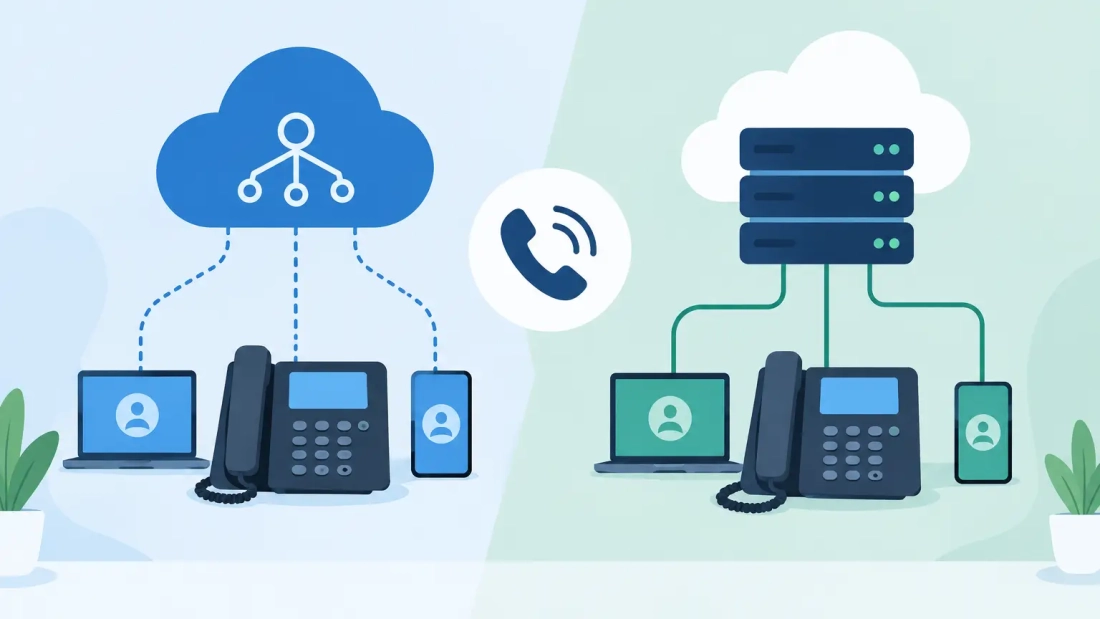
A phone system decision becomes urgent when the current one gets in the way: calls drop during busy hours, remote employees cannot transfer calls easily, or an aging on-site PBX requires another expensive repair. In the SIP trunking vs hosted PBX decision, the better option is not automatically the newest technology. It is the model that fits your existing equipment, internal IT capacity, continuity requirements, and plans for growth.
Both solutions use internet protocol to carry voice calls, and both can support business numbers, extensions, call routing, voicemail, and modern calling features. The key difference is where the phone system itself lives and who is responsible for operating it.
SIP Trunking vs Hosted PBX: The Core Difference
SIP trunking connects an existing phone system, typically an IP-PBX installed at your office or data center, to the public telephone network over an internet connection. A SIP trunk replaces traditional PRI or analog phone lines with virtual call paths. Your business retains the PBX hardware and much of the control over how calls are configured.
Hosted PBX places the phone system in a provider-managed cloud environment. Rather than maintaining PBX servers at your location, your team uses IP desk phones, softphone applications, or mobile devices that connect to the hosted platform. The provider handles the core infrastructure, software updates, and much of the underlying maintenance.
That distinction affects more than a monthly invoice. It changes who owns the technical workload, how easily employees can work from other locations, and what happens when a local office has a power or connectivity problem.
When SIP Trunking Makes Sense
SIP trunking is often the practical choice for organizations that already own a capable phone system and want to modernize their carrier connection without replacing everything at once. A company with a well-configured on-premises PBX, specialized call flows, paging systems, door access integrations, or contact center equipment may have good reasons to preserve that environment.
It also gives internal IT teams more direct control. They can manage dial plans, integrations, security policies, and system upgrades according to their own standards. For a larger organization with telecom expertise, that control can be valuable, especially when voice communications are tightly connected to other internal systems.
Cost can favor SIP trunking when existing PBX equipment still has useful life. Instead of purchasing a new cloud phone deployment, the business can move away from older telephone circuits and pay for the calling capacity it needs. Capacity can typically be adjusted as call volume changes, which is useful for seasonal operations, multi-site businesses, and organizations expanding in phases.
However, SIP trunking is not a hands-off service. The business remains responsible for the PBX, its configuration, software patches, internal network readiness, and often the technical diagnosis of call-quality issues. If the PBX fails, someone must repair or replace it. If the office loses power, the local phone system may be unavailable unless it has battery backup, generator support, and a continuity plan.
When Hosted PBX Is the Better Fit
Hosted PBX is designed for businesses that want a professional phone system without operating phone-system servers. It is a strong fit for offices with limited IT resources, growing teams, multiple locations, or employees who work from home, on the road, or across different facilities.
Because the call platform is hosted off-site, users can generally keep making and receiving calls from another internet-connected location or mobile application if a physical office becomes inaccessible. That does not eliminate the need for business continuity planning, but it gives organizations more options than a system tied entirely to one equipment room.
Hosted PBX also simplifies expansion. Adding an extension for a new employee usually does not require installing a new PBX card or redesigning the local system. A company can provision a desk phone, configure a softphone, assign a number or extension, and apply call-routing rules through the hosted platform. For a South Florida business opening a second office or supporting a distributed sales team, that flexibility can reduce friction.
The trade-off is less direct control over the core platform. Businesses can usually manage users, schedules, greetings, call queues, and many routing settings, but they do not administer the underlying PBX infrastructure. Highly customized integrations or legacy equipment may require additional planning, and recurring per-user pricing can become a significant consideration for larger deployments.
Reliability Depends on the Whole Voice Environment
Neither option guarantees clear calls by itself. Voice quality depends on the network carrying the traffic, the local LAN and Wi-Fi design, router and firewall configuration, and the quality of the endpoint devices. A congested office connection can affect SIP trunks and hosted PBX users alike.
For businesses that rely on calls for customer service, scheduling, sales, or emergency coordination, dedicated business internet and properly managed network policies matter. Voice traffic is sensitive to latency, jitter, and packet loss. Video meetings, cloud backups, large file transfers, and guest Wi-Fi can compete with calls if the network is not designed to prioritize business-critical traffic.
Hosted PBX can reduce the burden of maintaining voice servers, but it still needs dependable connectivity at each user location. SIP trunking can provide excellent reliability for an on-premises PBX, but it benefits from redundant internet paths, power protection, and a tested failover strategy. The right design should address the most likely failure points, not just the phone service itself.
Compare the Operational Trade-Offs
The decision usually comes down to ownership versus provider management. SIP trunking keeps the PBX closer to your control, while hosted PBX shifts more responsibility to the service provider.
Choose SIP trunking when you have a modern, supportable PBX; an IT team or telecom partner able to manage it; and a business reason to retain specialized configurations or local integrations. It can be a logical modernization path for enterprises and established offices that have already invested in voice infrastructure.
Choose hosted PBX when you want predictable administration, simpler scaling, built-in mobility, and less equipment to maintain. It is often the cleaner path for small and midsize businesses, new office deployments, and teams that need employees to answer business calls from anywhere without exposing personal mobile numbers.
There are also hybrid situations. A company may keep an on-premises PBX at a headquarters location while using cloud calling for remote teams. Another may use hosted PBX for most users but retain specialized analog lines or dedicated devices where required. The best design does not force every communications need into one box.
Questions to Answer Before Choosing
Before selecting a platform, document how calls move through the business today. Look beyond the number of desk phones. Identify call queues, auto attendants, shared lines, conference rooms, fax requirements, elevator or alarm lines, door systems, paging equipment, and any software that depends on telephony.
Then assess four practical areas:
- Existing investment: Is your current PBX modern, licensed, supported, and worth retaining?
- IT ownership: Who will handle upgrades, security patches, troubleshooting, and configuration changes?
- Mobility and growth: How often do you add staff, move locations, or support remote employees?
- Continuity requirements: Where should calls go if an office, internet circuit, or power source fails?
Security and emergency calling deserve specific attention. Whether you use SIP trunks or hosted PBX, protect administrative access, use strong credentials, keep firmware current, and review fraud controls. Confirm that emergency addresses are accurate for every location and that remote workers understand how emergency calling is handled from their devices.
Build the Phone System Around How Work Gets Done
A phone system should support the way your employees serve customers, not create another system for them to work around. If your priority is preserving a sophisticated on-site platform, SIP trunking may extend the value of that investment. If your priority is reducing local hardware and giving employees flexible access to business calling, hosted PBX may be the more efficient choice.
Start with your call flows, network conditions, and recovery expectations. A practical review of those details will reveal whether control, simplicity, or a hybrid approach gives your business the strongest foundation for every call that matters.