
A video meeting freezes while a large cloud backup starts. The sales team cannot access its CRM, customers wait on hold, and an employee working remotely loses their connection. For a business, the fiber vs cable internet decision is not just about a speed number on a monthly bill. It affects how reliably your team can serve customers and keep revenue-moving work on track.
Cable can be a practical option for some offices, particularly where budgets are tight or fiber is not yet available. But businesses that depend on cloud platforms, hosted voice, frequent file transfers, and real-time collaboration often benefit from fiber’s stronger performance profile. The right choice comes down to how your business operates, what downtime costs, and what infrastructure is available at your location.
Fiber vs Cable Internet: The Core Difference
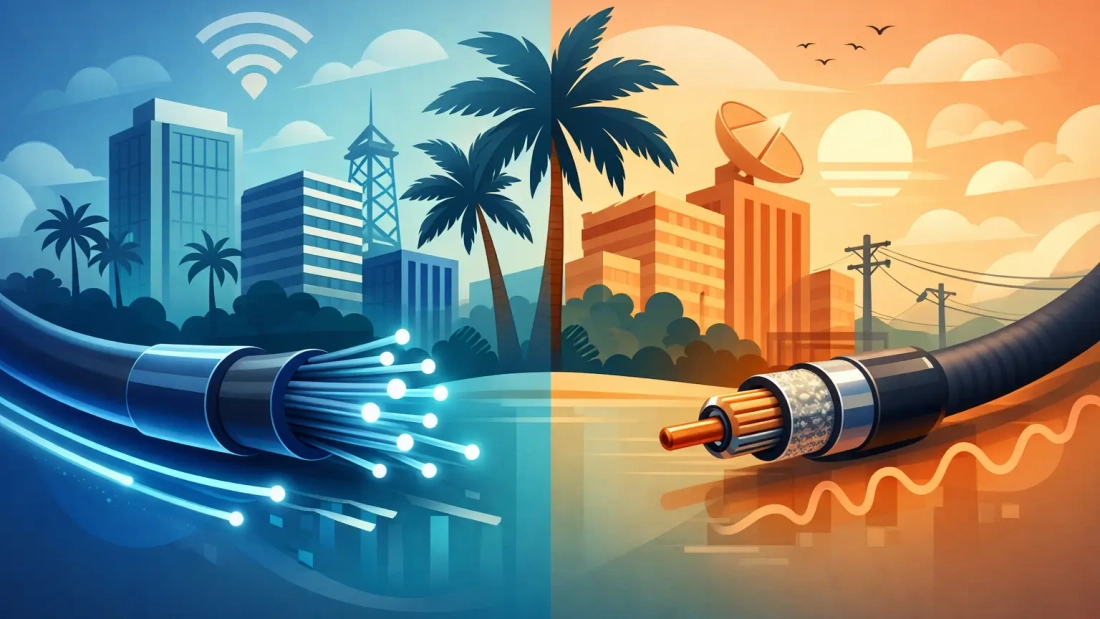
Fiber internet sends data as pulses of light through thin glass strands. Cable internet uses the coaxial cable infrastructure originally built for television service. Both can deliver high download speeds, but the underlying technology creates important differences in upload performance, capacity, consistency, and scalability.
Cable service is commonly delivered through a shared neighborhood network. During high-use periods, nearby users may be drawing from the same local capacity. That does not mean cable is always slow or unreliable. A well-provisioned cable connection can support many everyday business tasks. However, performance can vary more by time of day and local network demand.
Fiber has substantially greater capacity and is less affected by electrical interference. For business customers, it is often deployed as a dedicated or purpose-built connection with service terms designed around commercial operations. The details vary by provider and service type, so it is worth asking whether the connection is dedicated, shared, or subject to contention.
Speed Is More Than Download Speed
Internet plans are often sold on download speed because it is easy to recognize. Download capacity matters for browsing, streaming, software updates, and receiving large files. Yet upload speed can be just as important inside a working office.
Cable plans frequently offer asymmetrical speeds, meaning downloads are much faster than uploads. That may work well for a business whose internet use is mostly web browsing and email. It becomes a limitation when several people upload files to cloud storage, send design proofs, run offsite backups, host video calls, or use cloud-based phone systems at the same time.
Business fiber commonly provides symmetrical speeds, with matching download and upload capacity. A 500 Mbps symmetrical fiber connection can move data in both directions at up to 500 Mbps. That balance helps teams share large files, back up systems, support remote employees, and maintain clearer video conferencing without one activity crowding out another.
Symmetrical bandwidth does not make every application instantly faster. Wi-Fi coverage, aging network equipment, device performance, and application settings still matter. But it removes a common upstream bottleneck that cable connections can introduce.
Reliability and Consistency Matter During Business Hours
A speed test taken at 10 p.m. does not tell you how a connection will perform at 10 a.m. on a busy weekday. For commercial environments, consistency is often more valuable than peak speed.
Cable performance can be sufficient for a small office with modest needs. The trade-off is that neighborhood congestion and shared capacity can lead to more variable results. If your operation has few cloud tools, limited staff, and no major dependency on real-time systems, that variability may be acceptable.
Fiber is generally better suited to organizations that need predictable capacity throughout the workday. Law firms transmitting case files, medical offices using cloud systems, property managers coordinating field teams, and financial firms relying on secure online platforms all have less room for interruptions. The same applies to businesses that run point-of-sale systems, customer service platforms, or multi-location communications.
Internet technology is only one part of reliability. A business-grade service should also include clear uptime commitments, proactive monitoring where appropriate, and a defined support path when a problem occurs. A consumer-style support experience can become expensive quickly when an office is offline and employees cannot work.
What Fiber and Cable Mean for Voice and Cloud Applications
Hosted PBX and VoIP systems rely on a stable, low-latency connection. Voice calls do not require enormous bandwidth individually, but they are sensitive to delay, jitter, and packet loss. When the network is busy with uploads or downloads, calls can become choppy, delayed, or dropped.
Fiber’s symmetrical capacity and consistent performance give voice traffic more room to operate alongside other business applications. This is especially useful when employees use desk phones, softphones, mobile apps, and video meetings across one connection. Quality of Service settings and proper network design remain necessary, but a strong connection gives those tools a better foundation.
Cloud applications create a similar demand. Microsoft 365, Google Workspace, CRM platforms, accounting systems, file-sharing platforms, security cameras, and remote desktop tools all exchange data continuously. Cable may handle this workload for a small team, but fiber provides more headroom as user counts and application demands grow.
Cost: Compare the Total Operational Impact
Cable is often less expensive at the entry level, and that price difference can be meaningful for a startup or small office with straightforward connectivity needs. It may be the right short-term choice when usage is light and a service interruption would not create major consequences.
Fiber business internet can carry a higher monthly cost, particularly for dedicated service and higher service-level commitments. The better comparison is not simply the monthly rate. Consider the cost of lost employee time, delayed customer responses, failed transactions, postponed meetings, and emergency troubleshooting when the connection becomes a bottleneck.
A low-cost connection that repeatedly disrupts a 15-person office is not necessarily economical. On the other hand, purchasing far more bandwidth or redundancy than your operations require is not an efficient investment either. A practical recommendation should match the connection to your current workload and near-term growth plans.
Availability Is a Real Factor in South Florida
Fiber availability varies by building, street, and service area. Even in dense commercial corridors across Miami-Dade, Broward, and Palm Beach County, one property may have fiber access while the building next door does not. Construction timelines, building access agreements, and existing conduit can all affect installation.
Cable is more widely available in many areas and can sometimes be activated faster. That can make it useful for a temporary location, a new office awaiting a fiber build, or as a secondary connection for continuity planning.
Before choosing, request a site-specific evaluation. Confirm the actual service available at the suite, not just the neighborhood. Ask about installation lead time, upload and download speeds, data limits, equipment, support response, and any service-level agreement. These details are more useful than a generic coverage map.
When Cable Internet Is a Reasonable Choice
Cable can be a sensible fit for a small office with a limited number of users, light cloud usage, and no large or frequent uploads. It can also serve as a backup circuit when paired with a primary fiber connection. If the office can tolerate occasional performance variation and the budget is the primary concern, cable may meet the need.
The key is to avoid treating a residential or basic cable plan as equivalent to business connectivity. Commercial teams need to understand support terms, equipment responsibilities, static IP needs, and how the provider handles service issues that affect operations.
When Fiber Is the Better Business Investment
Fiber is typically the stronger choice for businesses that rely on video conferencing, cloud applications, large file transfers, hosted phone systems, remote access, or frequent backups. It is also a better fit for growing teams that do not want to revisit their internet decision every time headcount or software usage increases.
For organizations where uptime directly affects customers and revenue, business fiber’s symmetrical speeds, capacity, and support structure can justify the investment. AWBC helps South Florida businesses evaluate these requirements based on real workloads, not a one-size-fits-all speed recommendation.
Choose the connection that supports the way your team works on its busiest day, not the one that looks fastest or cheapest in a simple online comparison. That is where reliable connectivity becomes an operational advantage rather than another recurring expense.
Comparing connectivity for your South Florida business? See our business fiber internet options or contact AWBC for a location-specific recommendation.