
When a customer calls during a busy Monday morning, the phone system is not an abstract IT decision. It affects whether the call reaches the right person, whether a remote employee can answer it, and whether your team can keep working if the office loses power or internet. The VoIP vs landline business decision comes down to more than monthly cost. It is a choice about reliability, flexibility, support, and how your company operates day to day.
For many South Florida organizations, cloud-based voice has become the practical default because teams work across offices, homes, job sites, and mobile devices. Still, a landline can make sense in specific situations. The right answer depends on your connectivity, business continuity plan, call volume, and operational requirements.
VoIP vs Landline Business Systems at a Glance
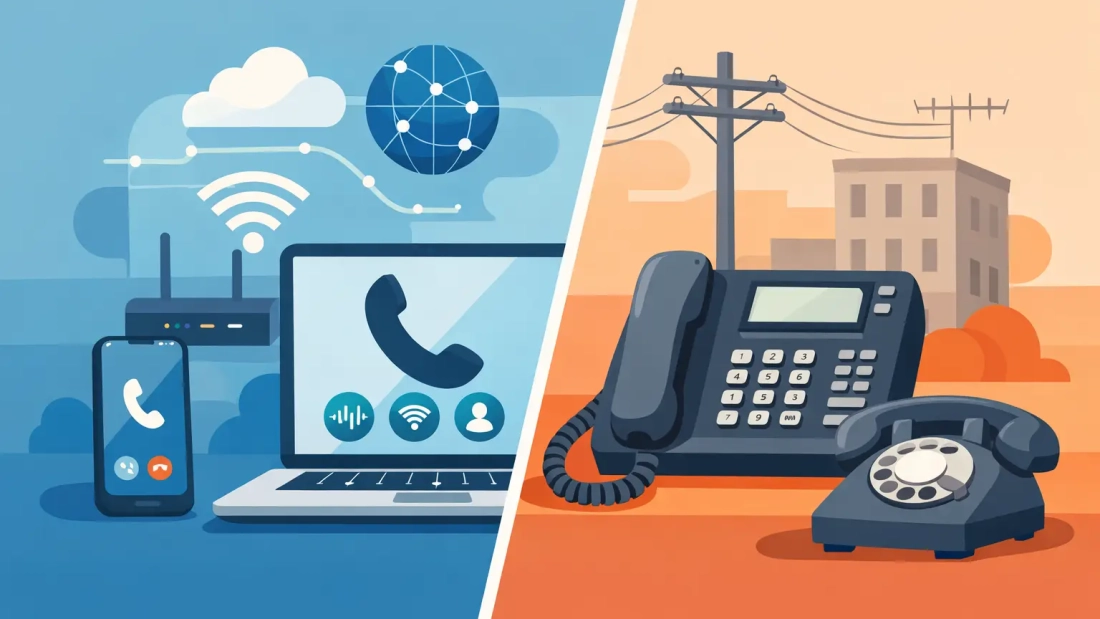
A traditional landline uses physical copper telephone lines connected to an on-premises phone system or the public telephone network. The phone service is tied to a location, and each line typically supports one active call at a time. It is familiar, simple to use, and historically known for staying available during certain local power outages.
Voice over Internet Protocol, or VoIP, sends calls through an internet connection instead of dedicated copper phone lines. A hosted PBX system manages calling features in the cloud, allowing employees to use desk phones, softphone applications, laptops, or mobile devices with the same business number.
That distinction changes how a business communicates. Landlines are built around a fixed office. VoIP is built around users, extensions, and call flows that can move with the business.
Where VoIP Delivers a Stronger Business Case
Flexibility for teams that do not stay at one desk
A landline extension typically exists at one physical location. If an employee is working from home, visiting a client, or supporting a second office, calls may need to be forwarded manually. This can create inconsistent customer experiences and make call coverage harder to manage.
With VoIP, an employee can answer calls from a desk phone in the office, a mobile app, or a computer headset. Calls can ring multiple devices at once, route to an available team member, or follow business-hour schedules. A customer still reaches the company number, while your staff gains the ability to respond from where work is happening.
This matters for law firms, medical offices, property managers, logistics teams, construction companies, and professional services firms throughout South Florida. The more mobile or distributed the team, the more value a cloud phone system usually provides.
Better calling features without a separate phone platform
Business landline systems can offer advanced features, but they often require a PBX, additional hardware, or separate service charges. Changes may involve a technician visit or a call to the provider.
Hosted VoIP systems typically include practical tools that help organizations manage calls more effectively. These may include auto attendants, call queues, voicemail-to-email, call forwarding, extension dialing, ring groups, business texting, call recording, and reporting. The specific features vary by provider and plan, so businesses should confirm what is included rather than assuming every feature is standard.
The value is operational. An auto attendant can direct callers to the correct department without tying up a receptionist. A call queue can prevent callers from reaching a dead end during peak periods. Voicemail-to-email helps managers act on messages even when they are away from the office.
Easier growth and lower change costs
Adding a landline can involve wiring, physical ports, equipment, and installation scheduling. Moving offices can require a more extensive project, particularly when the existing phone system depends on on-site hardware.
VoIP makes it easier to add users, assign extensions, update call routing, or activate new devices. A growing business can often scale its phone system without replacing core hardware. A company with seasonal staff or multiple locations can also manage users more efficiently than it could with a separate phone system at every site.
That does not mean VoIP is always less expensive in every scenario. Pricing depends on user count, features, internet requirements, equipment, and contract terms. But the ability to make changes quickly can reduce administrative friction and avoid unexpected costs when the business evolves.
Reliability Is Not Just a Landline Advantage
The strongest argument for a traditional landline has always been reliability. In many cases, copper phone lines could continue operating when a building lost commercial power because the phone line carried low-voltage power from the telephone network. That history still influences how many business owners view landlines.
However, the reliability picture has changed. Copper networks are being retired in many markets, and traditional phone service is not always the same independent, power-fed system people remember. Modern business operations also rely on internet-based tools for email, cloud applications, point-of-sale systems, video meetings, and customer platforms. A working analog phone line alone may not keep the operation running.
VoIP reliability depends on the quality of the internet connection, local network configuration, provider infrastructure, and backup planning. Poor Wi-Fi coverage, overloaded networks, or consumer-grade internet service can create call quality problems. A properly designed business VoIP deployment, however, can provide clear calling and dependable service.
For companies that cannot tolerate interruption, the priority should be resilient connectivity. Business fiber internet with symmetrical speeds, monitored equipment, service-level support, backup power, and a secondary connection can support both voice and core applications. AWBC helps South Florida businesses evaluate voice and connectivity together because a phone system is only as dependable as the network supporting it.
What Happens During an Outage?
This is the question that should drive the decision, especially during hurricane season. A landline may continue working during a local power outage if the network and phone equipment are still powered, but this is not guaranteed with every modern service configuration. Cordless phones and on-premises PBX equipment also need electricity.
VoIP phones in the office require power and internet access. The practical advantage is that calls can be rerouted quickly. If an office loses power, incoming calls can ring remote employees, mobile devices, or another location. Your staff may not be able to work from the affected office, but customers can still reach the business.
A sound continuity plan should include battery backup for network equipment, a generator where appropriate, documented call-forwarding procedures, mobile device access for key employees, and a backup internet option for essential locations. The goal is not to assume one technology eliminates risk. It is to plan for the failures that would interrupt customer communication.
When a Landline Still Makes Sense
There are situations where a landline remains a reasonable choice. A small location with minimal calling needs, no remote staff, and limited reliance on phone features may prefer a basic line for simplicity. Certain alarm panels, elevator phones, fax machines, and legacy equipment may also require specialized analog service or an approved alternative.
Some organizations keep a separate line for emergency use or as part of a layered continuity plan. That can be sensible, but it should be evaluated against the actual service type, local network conditions, and regulatory requirements. A traditional line should not be treated as a substitute for a complete outage plan.
Businesses with unreliable internet should fix the connectivity issue before moving all voice traffic to VoIP. Cloud phones perform best on stable, business-grade connections with sufficient capacity and properly managed network equipment. If video conferencing, cloud backups, file sharing, and voice all compete for an undersized connection, phone quality is only one of several operational problems that will surface.
Questions to Ask Before Choosing a Business Phone System
Start with how calls flow through your business. Consider whether employees need to answer calls outside the office, whether customers regularly reach multiple departments, and whether managers need visibility into missed calls and call activity. Then look at the network supporting those needs.
Ask your provider about uptime commitments, call-routing options during an outage, implementation support, number porting, equipment compatibility, emergency calling configuration, and response times when service is affected. If you operate more than one location, confirm whether the system can maintain consistent extensions, caller ID, and call handling across every site.
It is also worth reviewing internet capacity before selecting a voice platform. Symmetrical fiber service can be especially valuable for organizations that upload large files, use cloud applications, conduct video meetings, and need reliable voice quality at the same time. Unlimited data and business-focused support reduce the chance that normal growth turns into a connectivity constraint.
Choose the System That Supports How You Work
For most businesses, VoIP offers the better long-term fit because it supports mobile teams, makes call handling easier, and adapts as the organization grows. A landline can still have a place for a limited-use location, legacy device, or specific backup requirement, but it is rarely the most flexible foundation for a modern business communications strategy.
The best phone decision starts with an honest look at your daily operations and the connection behind them. When calls, internet, and continuity planning work together, your team can stay reachable when customers need an answer most.