
When your team is on video calls, your phones run in the cloud, and customer files live in SaaS platforms, internet performance stops being a utility line item and starts affecting revenue. That is why the question of fiber internet vs cable for business matters so much. The right connection can keep operations moving smoothly, while the wrong one can create daily slowdowns that chip away at productivity.
Fiber internet vs cable for business: the core difference
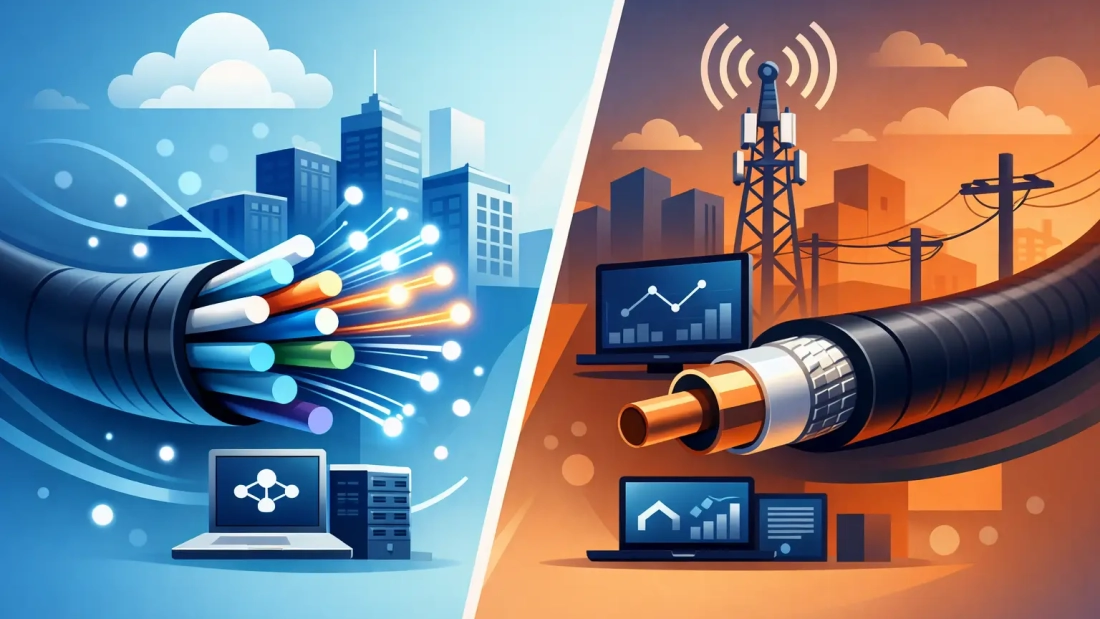
At a high level, fiber and cable both deliver business internet, but they do it in very different ways. Fiber uses light over fiber-optic lines, while cable uses coaxial infrastructure that was widely built for television and later adapted for internet access.
For a business owner or IT manager, the practical difference is less about the medium itself and more about what it means for performance. Fiber is typically associated with higher speeds, especially for uploads, more consistent throughput, and stronger support for cloud-heavy operations. Cable can still be a workable option for many offices, particularly where budgets are tight or usage is relatively modest, but it often comes with trade-offs that show up during busy workdays.
Speed is not just about downloads
Many businesses compare plans by looking at the download number first. That makes sense if your office mostly browses websites and streams content. But most modern businesses rely just as much on upload capacity.
If your team uses Zoom or Teams all day, sends large design files, uploads video content, runs cloud backups, manages hosted servers, or depends on VoIP phone systems, upload speed matters a lot. This is one of the clearest differences in fiber internet vs cable for business.
Fiber commonly offers symmetrical speeds, which means upload and download speeds are the same or close to it. A 500 Mbps fiber connection can often deliver 500 Mbps down and 500 Mbps up. Cable, by contrast, usually prioritizes downloads and provides much lower upload speeds. A cable plan may look fast on paper, but if the upload side is limited, everyday business tasks can still lag.
That imbalance tends to show up in ways teams notice quickly. Video calls become less stable. Shared files take longer to upload. Cloud backups stretch into business hours. Remote workers connecting to office resources may experience frustrating delays.
Reliability is where business internet earns its keep
For business environments, internet speed gets attention, but reliability is often the bigger issue. A fast circuit that drops out during peak hours is not helping operations.
Fiber generally has an edge here. It is less susceptible to certain types of signal degradation and is better suited to carrying high volumes of traffic consistently. In business-grade deployments, fiber is also more commonly paired with service-level commitments, proactive monitoring, and faster response expectations.
Cable can be reliable enough for some offices, especially smaller ones with lighter usage. But because cable networks often involve shared bandwidth across a local area, performance can vary more during busy periods. If the neighborhood is active, your speeds may not feel as predictable.
For a business, that variability matters. Customer calls do not wait for better bandwidth conditions. Neither do payment systems, CRM platforms, or support tickets.
Shared bandwidth vs dedicated performance
Not every business internet service is delivered the same way, even within the same technology category. That said, cable is often sold in shared-bandwidth environments, while business fiber is more often available with dedicated options.
That distinction matters if your company depends on steady performance all day. Shared connections can be cost-effective, but they are more vulnerable to congestion. Dedicated fiber is built for businesses that need a more consistent experience, particularly in offices with many users, multiple cloud applications, or bandwidth-intensive workflows.
If you run a law firm, medical office, logistics operation, multi-site company, or customer service team, predictable performance often has more value than an attractive headline speed. Consistency is what keeps work moving.
Uptime, support, and response times
The internet connection itself is only part of the buying decision. The support structure behind it matters just as much.
Business fiber services are often sold with stronger uptime commitments, defined service levels, and support teams that understand commercial urgency. That can make a real difference when a connection issue affects your phones, payment processing, or internal systems.
Cable internet for business may still include business support, but the service model is not always built around the same expectations. In some cases, repair windows are longer or support is less tailored to mission-critical use.
For some companies, that is acceptable. For others, especially those with customer-facing operations or distributed teams, every hour of downtime carries a direct cost. If an outage can stop your business, the monthly savings of a lower-tier service may disappear quickly.
Cost: cable usually starts lower, but context matters
Cable often wins on entry-level price. If you are comparing basic business internet plans, cable may look like the more affordable option, and sometimes it is.
But monthly price should not be evaluated in isolation. The better question is what the connection allows your business to do without interruption or delay. A lower bill is helpful only if the service supports your actual workload.
For a small office with light email use, web browsing, and limited cloud activity, cable may be enough. For a business that depends on hosted voice, large uploads, cloud collaboration, remote access, and daily video conferencing, fiber often delivers better value over time because it reduces friction.
There is also the issue of growth. If your company is hiring, adding locations, moving systems into the cloud, or handling larger files than it did a year ago, the cheapest option today may not be the most economical one six months from now.
Which connection fits which type of business?
This is where the answer becomes practical instead of theoretical. The right choice depends on how your business actually operates.
Cable can make sense for smaller offices with modest internet demands, limited upload needs, and a stronger sensitivity to monthly cost. If your team mainly uses email, browsing, and a handful of cloud tools without heavy real-time collaboration, cable may be enough for now.
Fiber is often the better fit for businesses that rely on cloud platforms throughout the day, use VoIP or hosted PBX, transfer large files, support hybrid teams, or need stronger uptime assurances. It also makes sense for organizations that want room to scale without replacing connectivity again in the near future.
In South Florida, this decision can carry extra weight because weather, operational tempo, and customer expectations all put pressure on communications infrastructure. Businesses across Miami-Dade, Broward, and Palm Beach often need more than basic connectivity. They need service that supports continuity.
Questions to ask before you choose
Before signing a contract, focus less on marketing language and more on operational details. Ask what your actual upload speeds will be, not just your download range. Ask whether bandwidth is shared or dedicated. Ask about uptime commitments, support response expectations, and whether the service is designed for business-critical voice and cloud traffic.
It is also worth looking at your own usage patterns. How many people are online at once? How often do you upload large files? Are your phone systems cloud-based? Do you rely on remote access, backups, or security cameras? These questions usually point to the right answer faster than raw speed comparisons alone.
A provider that takes a consultative approach should be willing to match service to your operations instead of pushing a generic package. That matters because internet is not one-size-fits-all, even within the same building.
The better choice is the one that removes operational risk
In the debate around fiber internet vs cable for business, fiber usually has the advantage for performance, upload capacity, consistency, and long-term scalability. Cable still has a place, particularly for smaller businesses with lighter demands and tighter budgets.
The key is to make the decision based on business impact, not just price or a headline speed number. If your internet connection supports calls, collaboration, customer experience, and access to core systems, then reliability and symmetry are not luxury features. They are part of how work gets done.
For many growing companies, that is why fiber becomes the better business decision. It is not just faster internet. It is fewer slowdowns, fewer workarounds, and fewer moments where connectivity gets in the way of serving customers.
If you are evaluating options, start with the cost of interruption. That number usually tells you which connection your business can actually afford.